
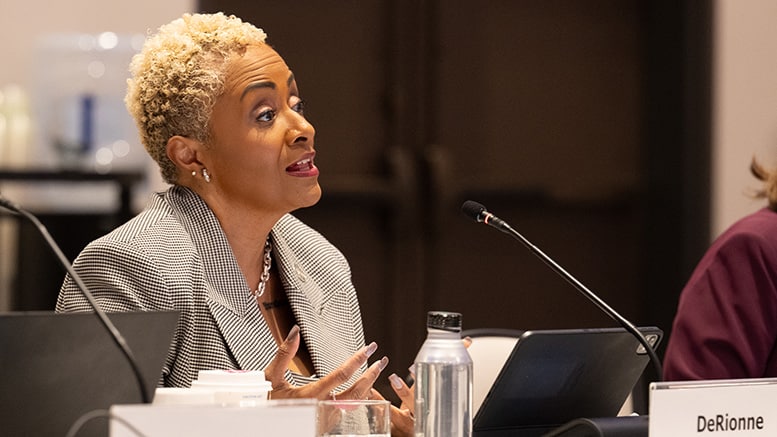
SEATTLE — The new president and CEO of the American Association of Community Colleges (AACC) this past weekend unveiled her vision for the association’s work for the next decade, but DeRionne Pollard is clear that she still wants to hear from members about what they like about it, what needs tweaking and what might be missing.
“It’s a living document,” she said during one of several listening sessions with college CEOs at the AACC annual meeting, two days after rolling out the association’s Strategic Compass 2035 at the opening plenary.
Monday’s CEO session was guided by a moderator who prompted conversations about the ambitious plan, asking members to consider its five larger “anchors,” as well as “strategic bets” that will serve like action items. Participants were encouraged to think how their colleges could tap into those elements and apply them at their institutions.
“What feels most alive and necessary? What makes you the most excited?” asked higher education consultant Trimeka Benjamin, who guided session participants to briefly chat with each other before relaying their thoughts to the broader group.
Top of the list was an appreciation that the strategy sets community colleges as “owning the space,” several presidents noted, adding that it presented a “narrative shift.” The blueprint sends a message that community colleges are not just passive players in various ecosystems but a central force. One president said it was a “Hallelujah” moment when Pollard detailed the plan at Saturday’s plenary.
A number of CEOs cited the importance of using data to support their work, which was a component in one of the five anchors of the Strategic Compass. One president explained that better data allows colleges to “flex our muscles” in telling their stories.
All for one, one for all
The college leaders also discussed the need to work together and support one another to get the job done, especially when faced with fiscal and political challenges and distractions. Another quick discussion focused on how colleges could partner to share resources, especially with smaller colleges that may lack staff for certain functions, such as human resources and professional development.
One president noted he would like to see AACC’s plan address the financial challenges and funding reform that colleges face. Another president said he would like to include language about the growing learning options the sector is providing, from short-term training and dual enrollment, to select baccalaureates. He added that he thinks it’s important to more explicitly differentiate community colleges from four-year institutions.
The group of presidents also mulled how the association could help them address certain areas of its strategy. For instance, AACC could provide training to help implement and operationalize the work on campuses and provide tools that colleges can use to self-assess how they are doing in key areas. Several leaders also discussed how AACC could develop networks to discuss challenges that CEOs may have with boards, political appointees and governance, in general.
Session attendees also addressed professional development for various stages of the presidency, something AACC is already developing. It will release a paper on the plan, perhaps as early as May, Pollard noted.
Although the overall strategic plan may seem very challenging for colleges, several leaders noted that it doesn’t mean they have to adapt it all at once; colleges can focus on the elements they need most, they said. One president suggested a starter guide to help colleges of all sizes to select what areas they could focus on initially.
“Thank you for the fresh voice,” one president added.