SEATTLE — Over the last 15 years, colleges have shifted from a focus on access to one on student success — primarily credential completion. Now, colleges need to focus on a different success metric: post-completion success.
“Completion is not enough,” said Davis Jenkins, senior research scholar at Columbia Univeristy’s Community College Research Center (CCRC), during a session at the AACC Annual this week. Instead, Jenkins said, colleges need to “ensure what they complete enables them to reach their goals.”
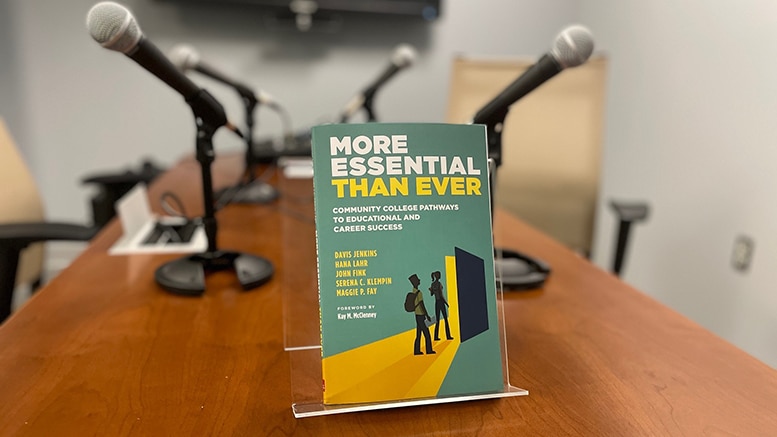
CCRC last summer released the book More Essential Than Ever: Community College Pathways to Educational and Career Success, which examines outcomes from guided pathways programs at community colleges and argues for improving post-completion outcomes for students.
“A lot of students are not on a clear path to a good job or to a bachelor’s degree,” Jenkins said.
He continued that to strengthen pathways for students, they should “start with the end in mind”: a credential that leads to direct entry into a living-wage job or leads to further education.
Getting to that result requires strong partnerships with employers and universities, opportunities for experiential learning for students, rethinking the onboarding process so students can explore and plan a program, and rethinking high school dual enrollment as a debt-free on-ramp to career-connected pathways.
Jenkins said the work is necessary so colleges can “provide what students came to us for: a clear, affordable, completable path to a better life.”
A new focus
Odessa College in Texas is one college doing the work. The college was an early leader in guided pathways work – and outcomes have been improving. Enrollment has more than doubled, from 5,000 to 11,000 credit students, and completion rates have increased.
But now, working with Aspen Institute’s Unlocking Opportunity program, they have new data on post-completion outcomes.
“I thought we were doing well,” said Odessa President Greg Williams. “My focus was not on the after-graduation part.”
Data on outcomes for general studies students was particularly alarming.
“We were doing them more harm than good,” Williams said. “We were taking their money, taking up their time, and they’re not able to be effective when they leave.”
Odessa has eliminated its general studies degree option because it was not serving students. At the time, there were about 1,000 students on a general studies degree path. Now there are two.
Also, advisors are empowered to be “intrusive” and direct students into pathways that meet their passions and goals.
Williams suggested that colleges really look at their data and be honest with themselves.
“If you show your employees where you are and where you want to be, that’s important,” he said.
His other advice was that college staff and faculty visit other colleges to see work in action.
Changing direction
Wyoming’s Laramie County Community College (LCCC) joined the second round of the American Association of Community Colleges’ Pathways Project nearly 10 years ago, looking to boost completion rates. LCCC’s graduation rate was 14%, and the top degree issued was in general studies.
“The guided pathways movement helped us to redesign at scale,” said LCCC President Joe Schaffer. “We were feeling good about getting students across the stage.”
But, like with Odessa College, the data showed something else: completion wasn’t cutting it. LCCC was producing graduates who weren’t getting jobs with family-sustaining wages or upward mobility. At the same time, transfer wasn’t working.
Now, LCCC’s work on guided pathways continues, but with a focus on post-completion success. The college has redesigned program on-ramps and pathways to increase retention, especially in programs that lead to good jobs – such as healthcare programs.
The college also created the Express Transfer program with a four-year university, which allows LCCC students in certain programs to be co-admitted to and co-advised by the university. From day one, students receive dual advising so they know costs and how to pay for their education, they build a relationship with university, and they “see the full path,” Schaffer said.
And LCCC is building a dual-enrollment pipeline. The college has advisors in high schools to help students understand pathways to educational and career success.
Schaffer’s advice for others doing this work is to have a long-term plan for how to tackle it so not every initiative gets launched at once.
“Roll it out in ways that make sense,” he said.
Also, colleges need to think about opportunities for engagement and commitment with the campus community. Building commitment requires evidence, giving others an opportunity to have a voice in the process and an opportunity to be part of the work.
And “stop using the word ‘buy-in,’” Schaffer said. “You’re not trying to have a transaction.”
Strengthening pathways
Hana Lahr, CCRC’s assistant director of research and the director of applied learning, presented alook at high-leverage strategies for strengthening pathways to post-completion success.
They are:
- Help transfer-intending students develop a major-specific transfer plan.
- Help students in low-value workforce programs build career advancement plans.
- Help students in competitive tracks develop a “Plan B” that leads to degrees and employment.
- Ensure dual enrollment provides on-ramps to career-connecting pathways.
- Build bridges to credit-bearing pathways for non-credit workforce and adult education programs.
CCRC recently released a Program Mapper tool designed to help colleges understand which of their students are — and are not — on a clear path to post-completion success.