The U.S. Navy announced Monday that it will provide $30 million to the Alabama Community College System (ACCS) to modernize and expand maritime workforce training at four south Alabama community colleges.
The funding will help the colleges to expand their submarine manufacturing and shipbuilding training programs and assist the Navy in building one Columbia-class and two Virginia-class submarines each year, which is a five-fold increase, according to ACCS. All community colleges across Alabama will also benefit from the programs’ expertise and contribute to the overall program, officials said.
The new funding will directly benefit Bishop State Community College and Coastal Alabama Community College, which already have a long history in maritime workforce training, plus Lurleen B. Wallace Community College and Reid State Community College. The investment will help to implement specialized curricula in maritime welding, structural fitting and pipefitting at all four colleges, the system said.
The colleges will also benefit from facility renovations and upgrades, new equipment, and expanded outreach and recruitment efforts that will more than double each college’s training capacity, according to ACCS.
The U.S. Navy has projected a need for 250,000 skilled workers nationwide in maritime manufacturing over the next decade, with nearly 10,000 new workers in the region alone, including pipe welders, pipefitters, structural welders, electricians and more.
The Trump administration has over the past several months announced direct and indirect funding to expand the country’s shipbuilding capabilities, including apprenticeships and pre-apprenticeships.
Skills and security
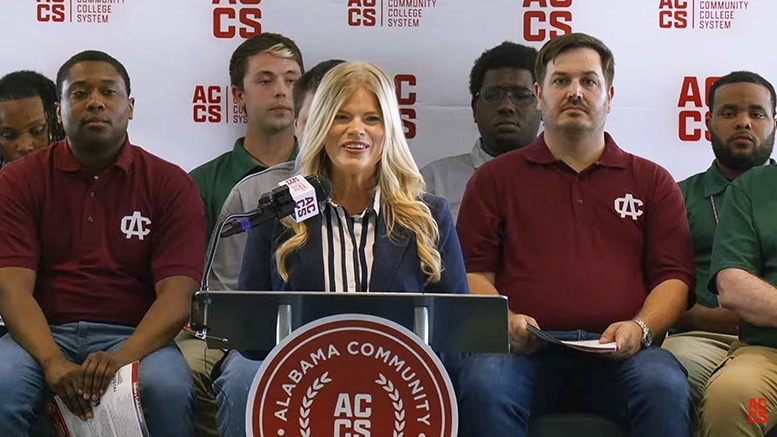
A press conference held by ACCS on Monday announcing the new venture included leaders from the Navy, Congress, state and local governments, manufacturers and community colleges. Several student speakers highlighted their experience in community college maritime training programs, including one student who got his start through dual enrollment.
Lindsay Cline, director of strategic partnerships for the Navy’s Submarine Industrial Base, recalled how last summer she and ACCS Regional Workforce Director Jennifer Hall joined a crew on a submarine for 11 hours to learn about their duties and the work of skilled shipbuilders.
“When you’re underwater, every weld matters; every measurement of every machined part, every wiring system is critical,” Cline said.
It’s not just a workforce and economic issue but also a national security issue, officials said.
In sync
Speakers noted the importance of partnerships in this venture, from federal, state and local governments, to shipbuilders, to community colleges, which will provide the training.
“Not only is our community college system relevant, they’re integral,” said Mobile Mayor Spiro Cheriogotis. “The future of our state and the city of Mobile is directly in the hands of our community college system, which is training the next generation.”
Austal USA, Mobile’s largest shipbuilder, is currently executing more than $750 million in facility expansions.
Cheriogotis gave kudos to ACCS Chancellor Jimmy Baker and his team for their vision and expertise in advancing the maritime training expansion. Baker, in turn, thanked college campus leaders, who share in-demand programs with each other and bubble up funding requests so system leaders can inform state leaders.
He said the new expansion follows the state’s embrace of auto manufacturing, making it a key industry in Alabama. The state’s automotive industry is a top national producer, ranking No. 2 for vehicle exports and among the top five states for overall production in 2025.
“This can be even greater,” Baker said.