At a time when many policy issues sharply divide the American public and their elected representatives, members of both major parties express support for community colleges as key drivers of upward mobility — perhaps none more so than legislators who got their start at community colleges.
“It’s informed my work a lot,” says Rep. Suzanne Bonamici (D-Oregon), a graduate of Lane Community College in Eugene, Oregon, who later earned bachelor’s and law degrees from the University of Oregon. “One of the reasons I came to Congress was to improve public education and open the doors of opportunity for more people.”
This excerpt is from an article in the current issue of the Community College Journal, published by the American Association of Community Colleges.
“I believe deeply in community colleges as engines of opportunity,” says Rep. Gus Bilirakis (R-Florida), a graduate of St. Petersburg College (then called St. Petersburg Junior College), who went on to complete a bachelor’s from the University of Florida and a J.D. from Stetson University College of Law. A member of the Congressional Community College Caucus, he adds, “Coming through SPC made me personally aware of how vital these institutions are for giving people a leg up.”
The American Association of Community Colleges (AACC) has honored several members of Congress from the Lone Star State with its Outstanding Alumni Award: Rep. Henry Cuellar (D-Texas), a graduate of Laredo College, received the award in 2015, and Rep. Randy Weber (R-Texas) received the award in 2025.
Weber, a graduate of Alvin Community College who received a bachelor’s degree from the University of Houston at Clear Lake, went on to found the air-conditioning company Weber’s Air & Heat in 1981 before being elected to Congress.
Cuellar received an associate degree summa cum laude from Laredo College before earning a bachelor’s degree from Georgetown University. He’s since added a master’s in international trade from Texas A&M International University, and a J.D. and Ph.D. in government from the University of Texas at Austin.
Charting a course
Bonamici, who represents Oregon’s 1st District, did not attend college immediately after high school, taking four years to determine her next direction. At first, she followed a high school work-study program that gave her retail sales experience into that field, then she had the opportunity to job-shadow in a legal aid office. After hearing stories about consumer protection issues, and people unable to afford their rent or health bills, “I thought, I’d like to be able to help these people,” she says
At Lane Community College, Bonamici went through the legal assistant program and became interested in law school, so she matriculated to University of Oregon.
“The two years at Lane Community College solidified my interest, my passion for helping others, and made a tremendous difference,” she says. “I don’t know where I’d be today if I had started college when I didn’t know what I wanted to do.”
Bonamici’s political career began in 2006 with her election to the state House, and then two years later she reached the state Senate, where she chaired the consumer protection committee and served on the education committee. She has served in Congress since 2012 is a leader on the Education and the Workforce Committee and founder and co-chair of the bipartisan Congressional STEAM Caucus focused on integrating arts and design with STEM education.
Serving students
One of Bonamici’s main goals has been to open up the doors of educational opportunity so that young people without significant family resources can follow paths like hers.
“When I think about my own story, working my way through the two years [at Lane], another two years, and another three years [of law school] on my own — I ended up with some student debt, but it was a manageable amount of debt,” she says. “I didn’t feel like I needed to go to a law firm to pay my loans. Today, people’s student loan debt is enormous.”
College students are not all 19-year-olds living in a dorm with a meal plan, Bonamici notes.
“I never lived in a dorm. I never had a meal plan,” she says. “I lived in shared housing with other people. I had what was then called food stamps. A lot of people don’t understand, many college students have kids, they need childcare. … There are homeless students, and students who are really struggling.”
Bonamici would like Congress to take a more active role in helping community college students pursue their ambitions, noting that, “sometimes, legislation is hard to pass here.” She adds, “The work-study formula has not been updated for a very long time. … I think back to the late Sen. Paul Wellstone (D-Minnesota), who said, ‘We all do better when we all do better.’ We have to open up the path to success for more people.”
In particular, Bonamici would like to see programs geared toward first-generation students to ensure that they can complete and not end up with debts and no degree.
While she would love to pass federal legislation establishing debt-free community college, as was contained in the original Build Back Better bill during the Biden administration, Bonamici doesn’t see that happening imminently.
“At the moment, we’re just trying to save the Department of Education,” she says. “Tennessee is a model. The state of Oregon has done a lot of work in that regard. Often times, states are the laboratories of innovation. It’s not a partisan issue. I hope Congress can do something like that and open up the door.”
A ‘secret weapon’
Bilirakis, who represents Florida’s 12th District, serves as a senior member of the Energy and Commerce Committee and chair of the Innovation, Data and Commerce Subcommittee in addition to the Community College Caucus.
While Bilirakis did not complete a degree at then-St. Petersburg Junior College, his time there was formative.
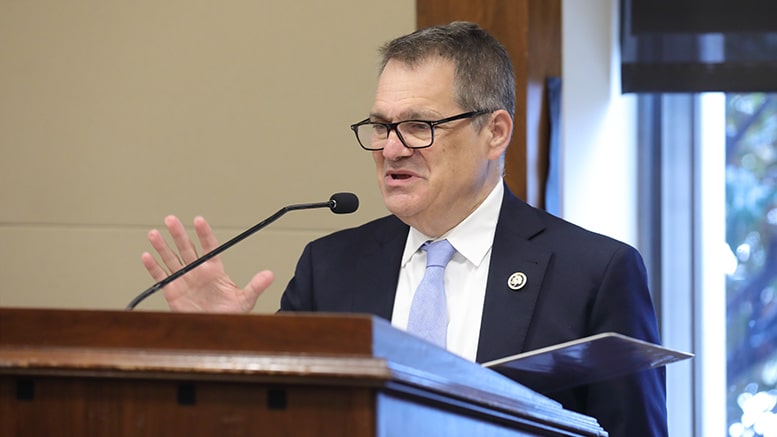
“It grounded me in community, reinforced the value of affordable, accessible education and taught me that higher education doesn’t always have to start — or end — at a four-year university,” he says. “That experience motivated me to pursue public service because I saw first-hand how critical community colleges are for giving people a chance — whether they’re coming from modest means, juggling work or looking for a second chance. … I’ve spoken publicly, calling community colleges a ‘secret weapon’ for economic development.”
Workforce development and more
Bilirakis says his community college roots continue to shape how he sees education policy and public service. In the Florida House, he supported legislation enabling community colleges to offer bachelor’s degrees and helped guide a bill that allowed STC to offer certain baccalaureates.
“On Capitol Hill, that means supporting workforce development, technical training and policies that help two-year colleges deliver value to students who may not want, or may not be able, to jump directly into a four-year program,” he says.
During his nearly two decades in Congress, Bilirakis believes that his colleagues increasingly have recognized the importance of community college. In 2025, he spoke at the National Legislative Summit – hosted by the Association of Community College Trustees, with the American Association of Community Colleges – about how two-year colleges are critical for workforce development and how important Pell grants are to that end. And he notes that Congress has maintained support for career and technical education programs such as the Perkins Act that channel resources into community colleges for job training, advising, career navigators and work-based learning.
“But there’s more work to do,” he says, noting he has supported creating a short-term Pell program, which finally happened last summer. “I also want to push for stronger partnerships between community colleges and employers, so schools can more directly align their training programs with workforce needs. Strengthening funding and support for community college infrastructure, particularly in underserved communities, is also a priority.”
Bilirakis’ background also inspired him to join the Community College Caucus as a platform to elevate community college-related issues “not just in rhetoric, but in real-actionable policy,” he says. The caucus has created a forum for members of Congress to talk directly with college presidents, trustees and students, helping to inform legislation and budget priorities, he adds.
“It also gives visibility to the unique challenges of community colleges, such as workforce alignment, funding, infrastructure and student support,” he says. “The caucus helps build bipartisan consensus for investing in two-year institutions as a foundation of America’s future.”