
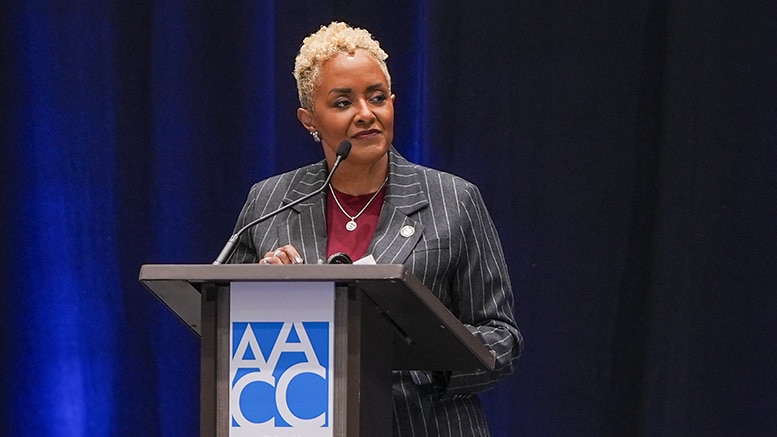
NEW ORLEANS — When it comes to improving career opportunities, it’s not just a job for community colleges. It’s the job of a broader “ecosystem” that encompasses various organizations and partners to work together through shared goals.
That was a key message from DeRionne Pollard, president and CEO of the American Association of Community Colleges, during a plenary on Thursday at AACC’s annual Workforce Development Institute. Pollard also encouraged community colleges to tell stories of success, particularly their efforts in providing students with economic opportunities to attain family-sustaining wages.
“Good jobs stabilize communities,” Pollard said.
Pollard peppered her speech with recent examples of community colleges, companies and community organizations working together to elevate students to new opportunities. Among them:
- Cyber security training efforts by Microsoft, IBM and Lockheed Martin through community colleges
- CVS Health offering free training in partnership with Columbus State Community College (Ohio) and other local organizations for pharmacy technicians and other positions
- The Lowe’s Foundation providing grants to community colleges to boost workforce preparation for the skilled trades
- Tesla and Panasonic ramping up battery production for electric vehicles
The jobs are “not just placements; they are professional pathways,” Pollard said.
Embracing a new approach
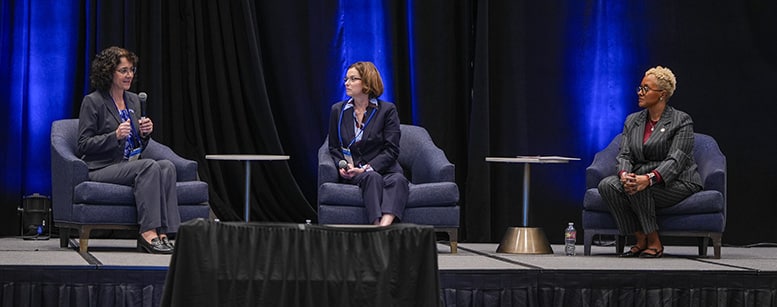
During a Q&A with Pollard after her speech, a pair of community college presidents who serve on the AACC board of directors shared their own examples of how they are addressing the challenges facing community colleges as outlined in AACC’s recent “Resilient by Design” report.
Marta Yera Cronin, president of Delaware County Community College (DCCC) in Pennsylvania, said she reflected on the report when it was presented to the AACC board last summer. It contained valuable information, but she mulled over what to do with it.
Cronin talked about it with her executive team, which decided to apply some of the report’s components into an application for an $8 million Department of Labor grant for shipbuilding. They decided three key elements would make them competitive: intersecting opportunity, innovation and national security.
The college received the grant, plus a lesson: “To get that grant, we did things that we would not have otherwise done,” Cronin said. Now, DCCC is exploring how to take elements of the grant into its other workforce development programs.
Pollard also reflected on the AACC report’s findings. She noted that colleges are facing many stresses, from enrollment to funding, but those challenging moments help to build resiliency, much like exercise builds strength and endurance.
“Stress is normative, but how we respond to that stress is what makes us distinctive as a sector,” Pollard said.
Claiming the space
Leigh Goodson, president of Tulsa Community College in Oklahoma and AACC board chair, noted that community colleges have for the past 15 years been on a journey to redesign themselves, but it’s been a slow process. It started with getting more students to commit to college, then it was completion and now it’s evolved into preparing students for jobs with family-sustaining wages.
Those changes in workforce development have caught the attention of media, lawmakers, business and industry, and the public. It’s also caught the eye of four-year colleges, which have themselves increasingly embraced the word “workforce” in their promotional and other materials.
Still, community colleges have an advantage over other higher education sectors because of their “deep competence,” said Pollard, explaining that community colleges have strong ties with businesses, and their faculty and staff draw on field experience they bring into the classroom.
But there is always room for improvement. Pollard said she would like to see the public two-year college sector move from a “collection of institutions, into a connected system of innovation.” That work requires a different type of leadership to ask difficult questions and to challenge traditional orthodoxies. She gave as an example the idea of semesters, which only exist in higher education. The business world, meanwhile, thinks in terms of weeks, not months, she said.