NEW ORLEANS — $66,000.
That’s the ambitious living-wage target that Arapahoe Community College (ACC) has set for its programs, whether in academics or workforce development. It illustrates that everything that the Colorado college does is geared toward good-paying jobs, said ACC President Stephanie Fujii. Even if students are majoring in, say, philosophy, its programs need to focus on landing students in jobs.
Students are “coming because they aspire to be able to provide for their families, for their loved ones, for themselves,” Fujii said at the opening session of the American Association of Community Colleges‘ annual Workforce Development Institute (WDI).
The $66,000 figure is a stretch goal for the college, but its faculty and staff are on board with working towards it, Fujii said. To help students earn those wages, ACC is approaching things differently. For example, college officials met with area aerospace firms — a big industry in Colorado — and asked them whether an engineer is needed for every one of their jobs. They responded no.
“Then why is that on every [job] posting?” Fujii said, adding that companies often struggle to articulate what they need in their workforce. What they require is the skills, not necessarily the degrees, she said. The goal for all community colleges should “not be degrees, but social and economic mobility.”
Fujii gave another example of a local hospital that wanted more medical assistants — and fast. ACC took its 18-month program and compressed it into a six-month program.
“You want to talk about innovation? That’s where innovation can truly happen,” she said.
Examples of resilience
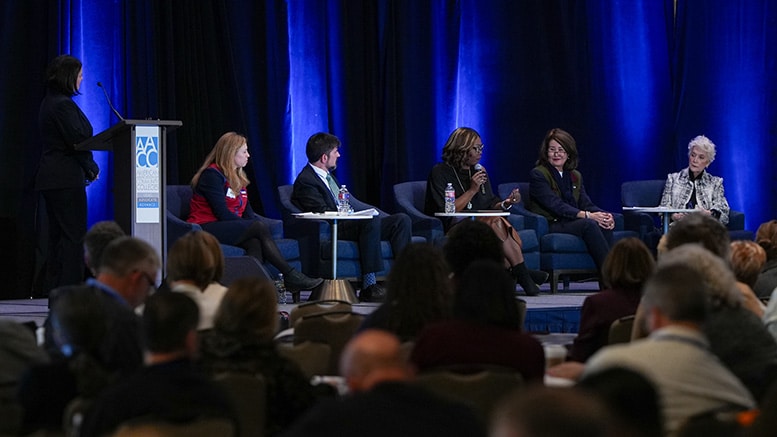
Fujii was on a panel of community college presidents and foundation representatives that discussed perspectives of AACC’s “Resilient by Design” report, released this fall. The document provides a snapshot of the range of pressures that community colleges face, from demographic shifts, to economic realignment and rapid advances in technology.
“Our colleges are being asked to respond to these challenges, and quickly, with very little runway,” noted Sunem Beaton-Garcia, president of Wisconsin’s Chippewa Valley Technical College, who moderated the panel discussion.
Each president provided an overview of their institution and how they are guiding their colleges in workforce and economic development. DeAnna Burt-Nanna, president of Monroe Community College (MCC) in Rochester, New York, highlighted the city’s significance in technology, noting its home to companies such as Kodak, Xerox and Bausch & Lomb. MCC has continued to provide workforce training into expanding fields, such as optical systems.
However, Rochester faces challenges with high poverty — three of the most impoverished Zip Codes in the state are in the area, Burt-Nanna said. That, in turn, is a challenge for the college, too. But to do the work, MCC needs investments. And to make its case with lawmakers, businesses and taxpayers, MCC highlights the return-on-investment, Burt-Nanna said. For example, every $1 an MCC student invests in their education yields $5.50 in return; For taxpayers, each $1 invested provides $2.50 in return.
MCC also emphasizes that most of its students are local — 80%, in fact — and they stay in the community. Nearly 88% that go to MCC stay in the state one year after graduation; two years later, it’s 82%; and five years out, it’s 78%, Burt-Nanna said. Those are figures she shares with stakeholders.
Burt-Nanna also highlighted the State University of New York system’s Reconnect initiative, which provides free community college tuition for older learners with no college credential to train in high-demand fields. The program, started last year, has provided about half of MCC’s enrollment growth, she said. Across the state, more than 16,500 New Yorkers this fall applied for the program, according to state officials.
Strengthening business partnerships
Charlotte Warren, president of Lincoln Land Community College (LLCC) in Illinois, agreed that workforce development is key for her college, too. It doesn’t mean that academics are not part of that, but “going to college is about getting a job,” she said.

Warren emphasized that colleges need to be intentional with their approach with business and industry. Including them in conversations about skills and seeking input into curricula design develops trust, which then leads to companies providing equipment for training, student scholarships and internships. In fact, five CEOs from area construction companies teach at the college’s new commercial construction lab.
“It’s not all just about construction or welding or HVAC,” Warren said. “It’s about everything that we do.”
LLCC is also exploring ways to mingle credit and non-credit programs, competency-based education and prior learning, plus support services and resources for students. The goal is to reduce barriers for students and businesses, too.
“I found that businesses didn’t even know who to talk to. If they needed something, they would call me, they would call the dean, they would call the faculty — and they would get that many different answers,” Warren said.
LLCC now has a business arm that acts as a one-stop shop for the college to serve businesses’ needs, she added.
Foundations’ viewpoint
Foundation representatives on the panel echoed much of the presidents’ comments. Betsy Conway, director of the Lowe’s Foundation, noted that employer connections are critical to help address workforce shortages in the skilled trades. That is a component the foundation looks for when evaluating grant applications from community colleges and nonprofits.
“We want to see that strong alignment,” said Conway, who encouraged colleges to “lean into innovation.”
Kermit Kaleba, strategy director for credentials of value at Lumina Foundation, outlined how the AACC report aligns with the goals of the foundation. He highlighted the foundation’s 2009 nationwide goal of reaching 60% of U.S. adults between ages 25 and 64 earning a degree or credential by 2025. When the goal was set, the national figure was at 38%; in 2023 (the latest available data), it reached 55%. Kaleba credited the work of community colleges and their partners for helping to push that number.
But stakeholders and institutional leaders didn’t think attainment was enough. Attainment had to be aligned with economic prosperity, Kaleba said. So in 2025, Lumina set a new goal: By 2040, 75% of U.S. adults should have a degree or credential that leads to economic prosperity, defined as earning at least 15% more than the national average for adults with only a high school diploma.
“Attainment needs to be for a purpose; this needs to lead to something more,” Kaleba said, noting that currently about 44% of adults have reached the new goal.
Kaleba added that, with community colleges’ focus on workforce development and the new Workforce Pell, he is hopeful that short-term certificates or certifications can push that figure upward.
The panel also discussed the role of accreditation, noting it needs to be flexible to allow colleges to be innovative, particularly with short-term programs.