House Republicans on Monday afternoon introduced their bill to revamp the nation’s main workforce development law, which would, in part, authorize the Strengthening Community College Training Grants Program.
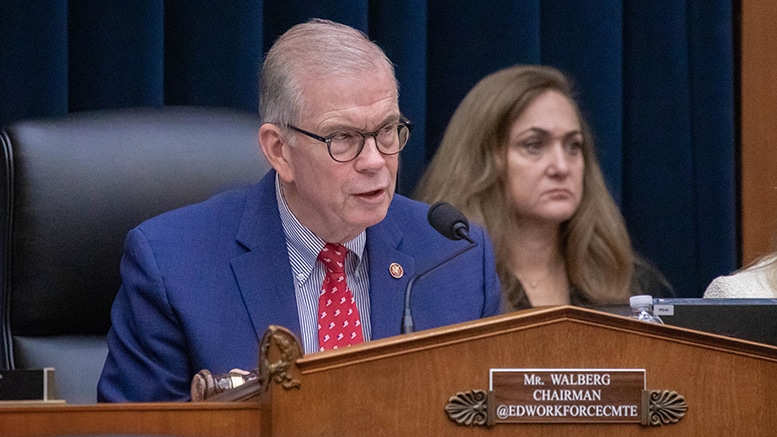
Introduced by Education and Workforce Committee Chair Tim Walberg (R-Michigan), the 506-page bill to reauthorize the Workforce Innovation and Opportunity Act — titled A Stronger Workforce for America Act of 2026 — would authorize $65 million in appropriations for the renamed Strengthening Community Colleges Workforce Development Grant Program. Authorizing and substantially increasing funding for the program to address severe skilled-worker shortages in key industries is a key legislative priority for the American Association of Community Colleges (AACC).
The proposed legislation also would create individual training accounts and a pilot block grant program for states and localities. In addition, it would permanently transfer oversight of adult education and literacy programs from the Education Department to the Department of Labor (DOL), which Republicans say would make it easier to connect adult education to apprenticeships, sector partnerships and employer-led training.
AACC will provide a more detailed analysis of the bill in the coming days, but below is a summary of areas of interest to community colleges.
Authorizing Strengthening Community Colleges grants
According to the bill, community colleges applying for Strengthening Community Colleges grants would need to establish an industry partnership with one or more employers in in-demand industries to carry out grant activities. Priority would go to applicants with plans to serve individuals facing barriers to employment or incumbent workers in need of foundational skills, as well as projects that would use competency-based assessments to award credit for prior learning.
The DOL secretary would establish levels of performance for each grantee on primary indicators of performance. Additionally, the secretary would evaluate the effectiveness of the grants, including the extent to which they developed or expanded industry sector strategies or career pathways.
Pilot program for block grants
The bill also would create a pilot program to allow states and local workforce boards to pursue reforms to their workforce development systems via Make America Skilled Again Grants.
“A state, local area, or consortium of multiple local areas with an approved pilot project will receive its adult, dislocated worker, and youth funds as a consolidated grant for five years with increased flexibility through waivers of statutory and regulatory requirements,” according to a summary of the bill.
The Labor secretary could approve up to 10 statewide pilot projects and eight local area or consortium pilot projects, and add two more states later.
Eligible provider list/one-stop operators
The bill would also update eligible providers of training services and operators of one-stop centers. Providers of registered apprenticeships and providers of Workforce Pell programs would automatically be included on the list of eligible providers of training services. In addition, area career and technical education schools, institutions of higher education, joint-labor management organizations and public libraries could serve as one-stop operators. The bill would permit virtual one-stop centers, but local areas opting for a virtual one-stop would be required to have at least two physical affiliated locations.