
During a House Appropriations subcommittee hearing on Wednesday, Democrats and Republicans lauded community colleges for their critical role in preparing students for in-demand jobs. However, the question is whether appropriators will back that enthusiasm with funding to support two-year institutions and their students.
Democrats on the Labor, Health and Human Services, Education, and Related Agencies Subcommittee called for funding increases for programs such as Pell grants and the Strengthening Community Colleges Training Grants (SCCTG) program. They even asked witnesses what the impact on community colleges would be if Congress cut funding for those and other programs critical to the two-year sector, alluding to the large cuts to higher education programs that the GOP-led House initially sought for fiscal year 2026.
“I’m proud that during this appropriations cycle (for FY 2026) Democrats were able to push back and prevent many of these programs from being eliminated entirely, which is no mean feat when the current administration is trying to dismantle the Education Department altogether,” ranking member Rep. Rosa DeLauro (D-Connecticut), said during the hearing, which focused on community colleges.
Republicans, meanwhile, mostly focused their questions on how to strengthen community college partnerships with business and industry to help cover training and equipment costs and to provide more paid work-based learning opportunities for students.
Rep. Andrew Clyde (R-Georgia) noted that community colleges are locally controlled, have strong employer ties, provide measurable return on investment and more. He coupled his comments with a shout-out to Lanier Technical College in his district for its work.
“These colleges are not chasing ideological trends and squandering taxpayer dollars,” Clyde said. “Instead, they are training nurses, welders, lineworkers, CDL drivers and skilled technicians — the very backbone of our national economy.”
Examples from the field
A panel of witnesses from three community colleges and a think tank painted for lawmakers the vast work that public two-year colleges do in connecting with local business and industry to develop the skilled workforce they need to thrive. Patricia Sims, president of J.F. Drake State Community and Technical College, a historically black community college in Alabama, opened the testimony by saying her college doesn’t participate in the federal student loan program because she doesn’t want students — who average 28 years old at Drake Tech — to take on additional financial burdens.
“We’re committed to providing students a pathway to a better life without burdening them with long-term financial obligations,” said Sims, who serves on the American Association of Community Colleges board of directors.
Instead, Sims works to maximize federally funded grants and other programs and to leverage business partnerships to provide paid work-based learning opportunities for students. She noted the importance of “gap scholarships” for her students, which provide funds to cover unforeseen student costs to ensure they don’t stopout.
Sims also emphasized that it’s not just about preparing students for jobs, but rather career paths. Programs such as the new Workforce Pell program, which launches July 1, can serve as a springboard to help learners develop entry-level job skills and build on those skills through additional programs, and, hopefully, advance into better-paying positions, she said.
Rural perspective
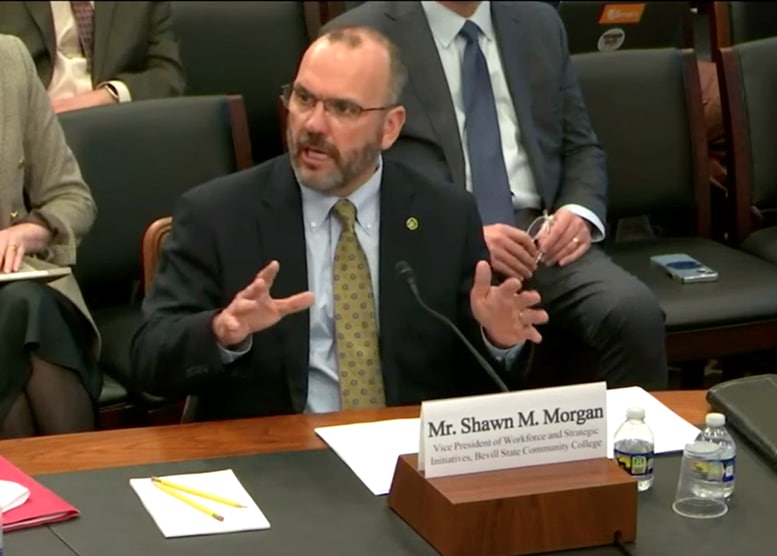
The committee also heard about the unique challenges faced by rural community colleges and tribal colleges. Bevill State Community College, for example, covers 260 square miles in its service area, where 70% of the population is eligible for Pell grants.
“That kind of tells you the need that we have in northwest Alabama,” said Shawn Morgan, the college’s vice president of workforce and strategic initiatives.
He highlighted some of Bevill State’s efforts in developing programs to serve local workforce needs, such as the Alabama Energy Infrastructure Training Center & Network, an initiative to boost training for jobs as lineworkers and positions in the fields of fiber connectivity and broadband infrastructure, solar/microgrid installation and maintenance, and electric vehicle and battery troubleshooting.
Community colleges like Bevill State are agile, which means they can rapidly develop curriculum, short-term programs, stackable credentials, flexible schedules and more to serve students and industry, Morgan said.
“Community colleges are the conduit between federal investment and local workforce impact,” he said. “We translate policy into jobs filled.”
Scaling up
Rep. Josh Harder (D-California), a former community college instructor, noted a successful nurse training effort at San Joaquin Delta College that produces 160 new nurses each year to help address local shortages. He asked how efforts like that can be scaled, from being local examples to serving as regional and national models.
Sims said programs like the Strengthening Community Colleges Training Grants program can help. She also noted Drake State’s partnership with Huntsville Hospital on a licensed practical nursing (LPN) program, through which students can become LPNs after three semesters. Industry provides support for students during the training, including tuition, books, fees and the opportunity to apprentice, according to her written testimony. In return, students agree to a three-year work commitment.
Shalin Jyotishi, managing director of the Future of Work and Innovation Economy Initiative at New America, added that the federal government can help scale up success through better federal interagency collaboration and coordination, noting programs run by the departments of Energy and Commerce that could benefit community colleges. More technical assistance could link successful college programs to foster high-impact practices.
Eye on dual enrollment
Sims and Morgan also discussed the importance of dual enrollment in providing high school students with college experiences that yield college credits. Across Alabama, more than 40,000 high school students are dually enrolled — a 230% increase since 2015, Morgan said. At Belvill State, dual enrollment has jumped 130% over the last four years.
“In rural counties where economic opportunity may appear limited, dual enrollment changes life trajectories,” Morgan said in his written testimony.