Community college marketing and communications staff play a key role in providing the visuals and storytelling in a college’s efforts to educate and influence lawmakers and other stakeholders.
That may seem obvious, but it’s sometimes an area that can be further strengthened as colleges build coordinated advocacy efforts that merge data with student and employer stories when they seek support from lawmakers.
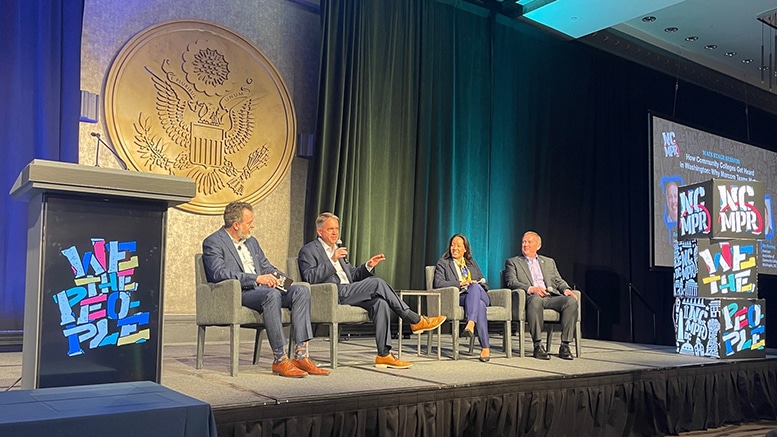
A panel of government relations staff from community colleges and the American Association of Community Colleges (AACC) addressed the “mar-com”/government relations efforts at the National Council on Marketing & Public Relations annual conference last week in Washington, D.C.
It all begins with program outcomes that illustrate the benefits for students, employers and the community itself, said Fiona Lytle, chief government and external affairs officer at the Colorado Community College System. Today, much of that message focuses on workforce and economic development, which are hot political topics.
Lytle said a good way to frame it is: “How does the community move forward with the community college at the forefront as a leader in economic and workforce development?”
Based on data
Gathering and sharing data can drive the overall point for colleges with legislators. Jim Hermes, AACC’s associate vice president of government relations, noted the importance of keeping lawmakers’ staff informed, who might know little about community colleges. He said AACC’s annual Fast Facts provides useful data points on community colleges, covering critical information about the sector and its students.
Hermes said his approach is to help staff understand the issues, which in turn helps them do their jobs. He noted that staff usually have half a dozen policy areas to cover, with higher education among them.
Meanwhile, student stories help personalize the data, allowing lawmakers to see the impact of programs on individuals in their communities.
A powerful visual that Harper College (Illinois) uses is a map that overlays the college district and the legislator’s district to show how many students are in their area.
“It’s a really quick visual that helps them understand,” said Jeff Julian, Harper College’s chief of staff and vice president of external affairs.
Lytle added that it’s also important to learn the background of legislators — whether they or their children attended community college — and their passion areas, which can help develop deeper connections, Lytle said.
The long game
Brett Rowlett, executive director of external affairs at Lane Community College (Oregon), said advocacy is a long-term game, not based on just one visit with lawmakers. It’s important to have a consistent message with lawmakers “until it sticks,” he said, noting that legislators have numerous meetings throughout the day, so the message needs to be one they remember.
It’s those long-term relationships that yield support for the college, Rowlett added. He said that he makes a point to have coffee with a legislator’s district officers several times a year to connect with them. Last month, Lane Community College received $1.6 million in federal funding to help buy equipment for its new Industry and Trades Education Center. It was among the more than $92 million Oregon’s senators secured as earmarks for community projects throughout the state.
“Think about how much it costs for a couple cups of coffee throughout the year. It’s definitely worth it,” Rowlett said.
Student storytellers
Students themselves are wonderful storytellers. They can tell personal stories about how changes in state aid or to Pell grants affect their ability to go to school, or how challenges with childcare can sidetrack their studies, the panel said. AACC’s Hermes said he showcases the impact of community colleges to congressional members and their staff through students’ lenses.
“That combination between data and personal stories are always the most effective way to go,” Hermes said.
The panel also recommended building a repository of students who can speak about their experiences before lawmakers. Colleges are often tapped, with short notice, to have students speak at a hearing or other event.
“Develop the materials before you need them,” Rowlett said.
Other supporters’ stories
Employers are also crucial community college storytellers, who can pitch the importance of colleges’ workforce development programs in their communities. College leaders also have a role: Presidents can present the institutional view, discussing strategies, enrollment and more, while trustees help to connect with legislators.
Harper College uses its board chair’s experience as an alumnus to make the case for improving how data on community college students is captured and shared. The trustee transferred to Loyola University Chicago, where he earned his bachelor’s and law degrees. But many metrics don’t capture his time at community college, so it doesn’t appear to have played a role in his success, Julian said.
“We use his story when we talk about the College Transparency Act and the accountability framework that we want for measuring community college success,” he said.
Julian added to include lawmakers themselves among colleges’ audiences. They can help share a college’s stories with colleagues, constituents and other stakeholders.
Rowlett noted that if legislators question the value of a college education, it may hint that the community itself may not know the college’s return on investment. So it’s probably a good time to remind them and share the college’s newer programs and efforts, he said.