Editor’s note: This is the second of two articles exploring how some community colleges are expanding the use of credit for prior learning. The first piece is here.
In California, the statewide approach to awarding credit for prior learning (CPL) has happened organically over the last eight years.
It started with wanting to help student veterans. In 2017, at Norco College, Samuel Lee – then the college’s vice president of academic affairs – wanted to expand access for recent veterans, which included making it easier to award them credit for military experience.
The college received seed funding from a state legislator to build a regional veterans resource center on campus and to develop – with faculty expertise – the Military Articulation Platform to automate the process to articulate their military transcripts.
Use of the platform grew to 12 colleges in the region. Then, with another $2 million in state funding, it scaled up to 55 colleges.
“That was a big step for us,” Lee says.
And another $2 million in funding helped it spread to 76 colleges.
The ‘aha’ moment
That’s when the “aha” moment occurred, Lee says. “If we give credit for veterans, why not automate the process to help others?”
The Military Articulation Platform was renamed the Mapping Articulation Pathways platform – or MAP – as the vision for CPL expanded to include all forms of prior learning. The MAP dashboard shows how much CPL colleges are offering and allows students to find course-specific CPL at all 116 colleges.
A $3 million federal grant helped with more scaling and building out the platform.
“There’s good momentum in the state. Colleges are starting to click on it,” Lee says.
Despite the excitement, there was also a steep learning curve.
“We were building this plane as we flew it,” Lee says. As the CPL processes and platform were being designed, they were continuously tweaked based on feedback.
Scaling up
In 2023, when Sonya Christian became chancellor of the California Community Colleges, she brought on a team to work on the statewide CPL approach. Lee joined as the senior advisor to the chancellor for credit for prior learning. In 2024, she launched the CPL demonstration project supported by $3.5 million.
Gov. Gavin Newsom has bought in on the importance of CPL, too. He’s designated state funding to help sustain the work. In 2024, $6 million was provided to support scaling. In 2025, $5 million in ongoing funding was authorized for MAP operations and technology development and $15 million for continued CPL infrastructure scaling. His proposed budget for 2026 includes an additional $2 million ongoing funding and $35 million to support the big lift of local colleges to ramp up CPL procedures.
The $35 million will be awarded to colleges based on their CPL outcomes, including the total number of students served, and provide colleges with a reimbursement based on the amount of credits they transcribe.
“That will really juice the system,” Lee says. “Even rural colleges will have a decent amount of money to support ramping up CPL efforts.”
Refining it
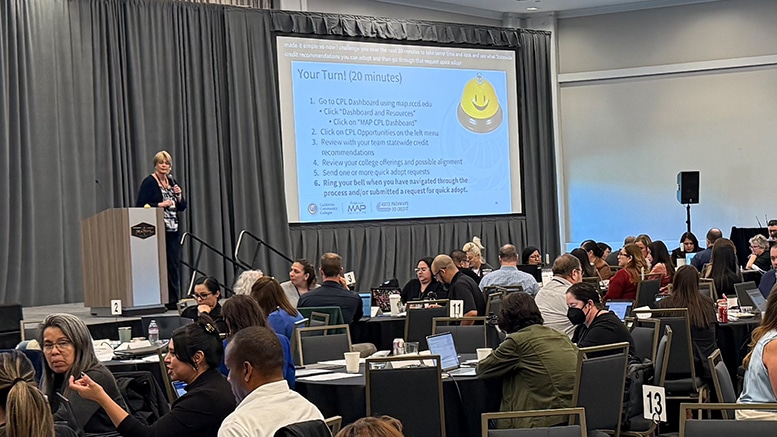
Lee and his teammates are meeting with colleges every day to help them with this implementation work. They also do regional trainings throughout the year to convene colleges.
“All colleges are at different levels,” Lee says. About 30 of the 116 colleges in the system are still working toward implementation.
Despite the statewide approach, each of the 72 governing bodies in the community college system makes decisions about which prior learning it’ll award credit for.
“This is not a top-down approach,” Lee says. Instead, it’s “participatory governance.”
To date, there are more than 40,000 students in MAP platform. And the cost to students? It’s free, though colleges can charge a fee for credit-by-exam. Lee hopes even those fees will disappear for students soon.
The team’s work also involves smoothing out concerns about transfer of credits awarded for prior learning. One of the biggest transfer partners is California State University, which accepts all awarded credits. However, University of California institutions are locally governed, and each can set its own policies.
Counselors at the community colleges work with students to help them understand what credits will transfer to which institutions.
There’s still some refining to do and areas to expand. For example, Lee wants to reach more of the 6.8 million working adults who have experience and learning but no credential – and particularly ensure journeyworkers get the credit they deserve. He also wants to see credit-by-exam expanded and automated the way, for instance, assessment for industry-recognized credentials.
But, thanks to system and state support and buy-in from the colleges, Lee knows the work can get done.
“I’ve seen all these fads come and go, and if this is a fad, it’s a great one because it only does great things for our students by pumping access and completion — and in the long run increasing funding for the colleges,” Lee says.