NEW ORLEANS — A year ago, Tyson Foods closed a meat-processing facility in Emporia, Kansas, laying off 800 employees in a community of 24,000. Flint Hills Technical College (FHTC), which was part of a local rapid response team, quickly provided short-term truck-driver training to displaced “shag drivers,” who handle the logistics of moving trailers to load and unload.
Three weeks later, those workers had a commercial driver’s license and were, in many cases, earning more than their previous jobs.
“These folks who lost jobs probably paying them in the 60s to 70s, they’re stepping into that $80,000 job now,” said FHTC President Caron Dougherty.
It was a team effort, Dougherty noted, that included community and government organizations — the state provided $4,500 per worker for the training — but she is particularly proud of how nimble her college was, something no other higher education institution in the area could do. It’s an example of the type of “ecosystem” of which community colleges are a part and highlights how rural colleges are quick adapters to the needs of students and local business and industry.
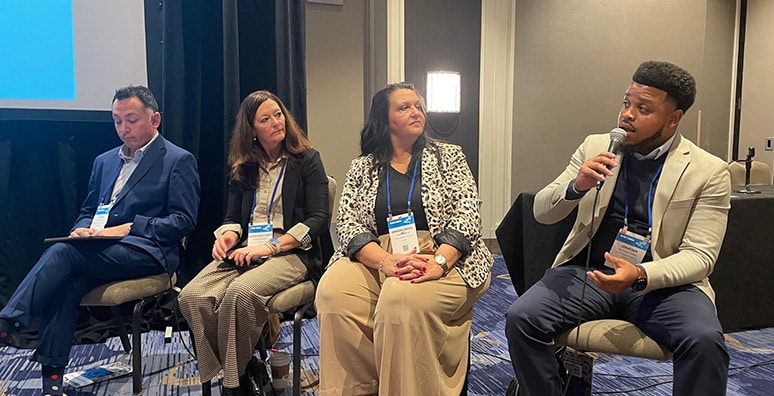
Dougherty and leaders from other public two-year colleges spoke on a panel discussion about unlocking the potential of rural colleges at the American Association of Community Colleges’ Workforce Development Institute.
A seat at the table
Dougherty said there’s a growing appreciation of FHTC in her area, especially when employers interested in moving to the community want to know about training opportunities for their employees. She noted FHTC is a voting member of the local economic development council — four years ago, it wasn’t — and two years ago it became a voting member of the local chamber of commerce.
Steve Sauceda, vice president of workforce development at New Mexico Junior College (NMJC), said those seats at tables with businesses are important in developing deeper roots and talking to potential new clients.
“No one knows what you’re doing unless you tell them,” he said.
It’s also important to have close relationships with state officials. When they call, answer, Sauceda said. The state higher education department will often call NMJC for a meeting with about two days’ notice, and NMJC officials have to drive 317 miles to meet them in the state capital. But it’s crucial to be at the table.
“Make sure you are there creating awareness,” Sauceda said. “I promise you one thing: they notice when you’re not there.”
Those relationships paid off for NMJC several times. Its advocacy, in partnership with other organizations, to secure grants for noncredit programs led state lawmakers to invest $60 million in workforce development, with $20 million per year disbursed for short-term training. But the funding to colleges was based on full-time enrollment — and most students in short-term programs attend part-time, Sauceda said.
Still, NMJC used its nearly $500,000 allotment entirely for scholarships, covering 80% of a student’s cost to participate in workforce development. So, for students in a commercial driver’s license (CDL) program, their out-of-pocket cost was about $600. But that amount is still a challenge for many students, Sauceda said. That’s where relationships with private industry matter; NMJC was able to secure funds to cover those last dollars.
Be innovative with opportunities
Even when the state says no to a request, learn to create opportunities, Sauceda said. NMTC created two EMT programs, one basic and one advanced, with the basic program serving as a prerequisite for the advanced program. But the state decided to fund the advanced program and not the basic one. The college approached other funders and asked how they could partner.
The college also ran into a roadblock with English on certain CDL exams. The first two requirements can be done bilingually in the state, but the final test, as required by the federal government, must be in English. The college decided to create its own training for it, which is how the 16-hour English for the Workplace program was born.
“We decided to find a solution,” Sauceda said.
In fact, NMTC used the CDL manual as a textbook for the course before students even started their CDL training.
“100% of students who take English for the Workplace first pass their CDL exam the first time. Why? Because we addressed the language issue instead of making it someone else’s problem,” Sauceda said.
How to stand out
When asked how their institutions stand out in an increasingly crowded education and training environment, the panel gave a range of replies, from providing niche training and focusing on market-driven curricula, to simply changing terms.
Pima Community College‘s market-driven programming requires the college to know its community well, such as the needs of potential populations. It leans on data to determine, for example, high school graduation rates, labor participation rates and even more specific information, such as how many 16-to-24-year-old residents are not working or not in school, said Amanda Abens, Pima’s assistant vice chancellor for workforce development.
In Mississippi, Hinds Community College is focused on continuing to map pathways for students, said Jonathan Townes, vice president of career and technical education, sponsored grants and HBCU initiatives. Over the past year, Hinds has mapped a pathway for students in non-credit programs to transition into for-credit coursework that leads to short-term credentials and even degrees. The college is also examining how to better serve more high school students in earning career and technical education credentials.
Meanwhile, NMJC is also addressing non-credit-related issues, but it started with dropping the word “non-credit.” The term doesn’t appeal to potential students, and families translate it to mean “it doesn’t mean anything and doesn’t count towards anything,” Sauceda said. Instead, the college is transitioning to the term “professional credit,” he said.