Northern Virginia Community College (NOVA) produces about 80 to 90 nursing graduates each year — but the major hospital system in its service area needs about 500 annually. The supply-and-demand gap is even wider for surgical technicians, MRI technologists, lab scientists and other positions.
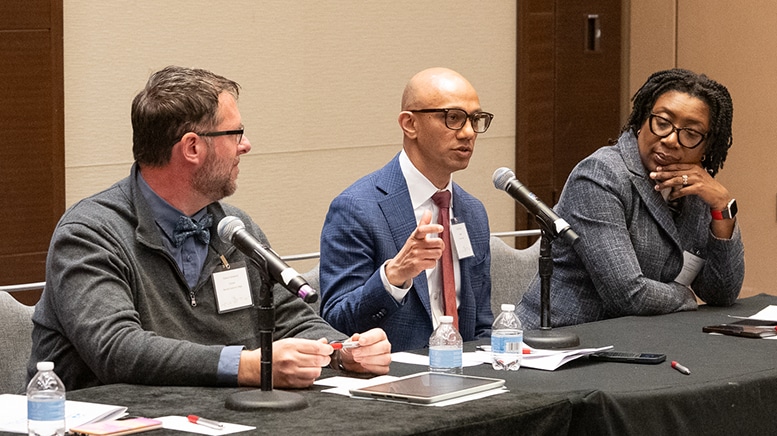
That’s according Raj Chand, president of Inova Fair Oaks Hospital, one of the campuses of Inova Health System, which serves over two million individuals annually through its hospitals and outpatient centers. But healthcare is not the only high-growth industry that is facing challenges in finding enough skilled workers.
Chand participated in a gathering held last Thursday by the American Association of Community Colleges (AACC) in Washington, D.C., of stakeholders to discuss community colleges’ role in workforce and economic development, as well as a deeper dive into four high-growth fields: healthcare, advanced manufacturing, cybersecurity/information technology and bioscience.
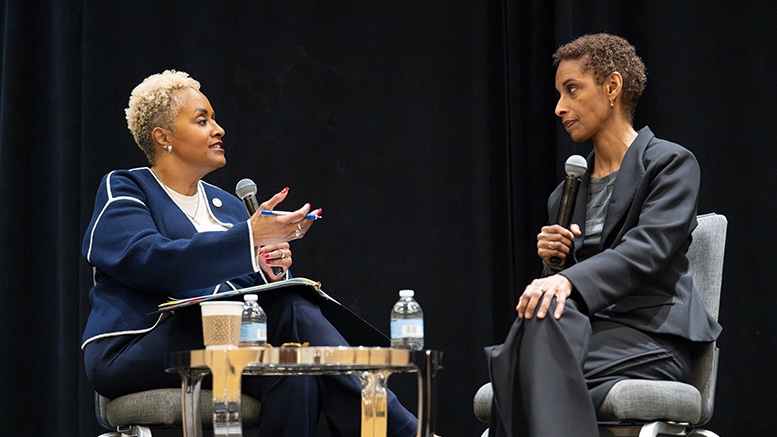
AACC President and CEO DeRionne Pollard opened the day-long meeting with an overview of two-year colleges’ and their partners’ roles in the workforce “ecosystem.” She also emphasized that it’s not just about college access and competition anymore, or about simply getting a paycheck, but about pathways to family-sustaining jobs — a theme echoed throughout the day.
“The talent pipeline that should supply these workers is in many cases still a patchwork — strong in some places, fragmented in others, and stretched thin by forces larger than any one institution or sector,” she said. “That’s why we are here today: to look honestly and vigorously at what is working and what can be improved.”
A closer look
Breakout sessions at the AACC event provided panel discussions that included leaders from colleges and businesses, policymakers, researchers and students. In the healthcare session, participants covered a range of topics, from deeper employment partnerships and rigid higher education structures, to career pathways for students and equity.
Chand, who serves on NOVA’s 11-member board, said the Inova system has evolved in its engagement with the college — something he recommended all employers do with their community college partners.
“We have shifted our mindset that we are no longer here to recruit; we are here to serve on your advisory board, create robust clinical experiences for students and more,” he said.
The panel discussed not only the technical skills needed for jobs, but the foundational or adaptive skills — such as critical thinking, communication and collaboration — are crucial for career advancement.
“Those adaptive skills allow you to go from one level of the organization to the next, to go from a CNA, to an RN, to an RN administrator or chief nurse,” Chand said. He added: “I think those human skills are going to be even more important in the age of technology than they are today.”
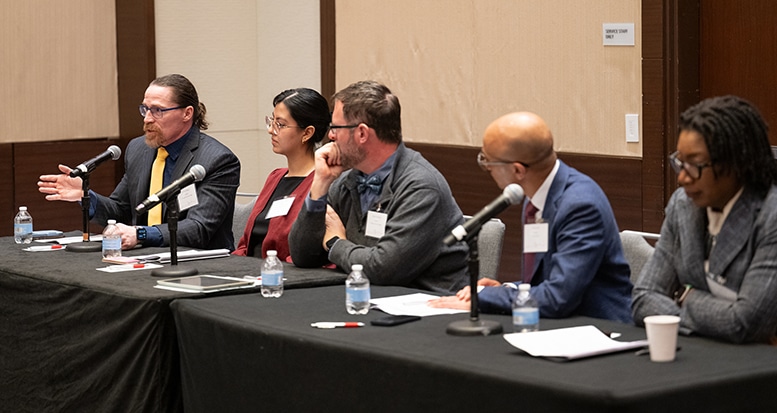
Greg Peterson, president of Salt Lake Community College (SLCC) in Utah, emphasized the need to provide career pathways for students. He noted that too many students take courses to break into a field, like healthcare, only to get stuck in low-paying jobs. He gave the examples of CNAs (certified nursing assistants), who are the largest number of healthcare hires. But these workers have low wages and experience the highest turnover. To address that, SLCC is working with a hospital partner to provide CNAs with coaches to guide them through career options at the hospital.
Nicole Smith, a research professor and chief economist at the Georgetown University Center on Education and the Workforce, noted the importance of providing wraparound student services, financial aid that covers living expenses and paid work-based learning opportunities. These supports are important for low-income, first-generation and students of color who face the greatest barriers in career pipelines, she said.
Student voices
Student participants on each panel mentioned the value of work-based learning experiences. Briana Wood, a 2024 graduate of Virginia Western Community College who earned an associate degree in design mechatronics engineering and is currently pursuing a bachelor’s degree in mechanical engineering technology at Old Dominion University, emphasized the value of internships.
“Those internships are vital, vital, vital,” Wood said, noting she has had three summer internships through Rhenus Automotive LLC, a German company that focuses on vehicle manufacturing and assembly. Her career goals include a role in trackside engineering for an International Motor Sports Association Grant Touring race team.
Edward Schwerkolt, who is studying at J. Sargeant Reynolds Community College in Virginia to become a medical laboratory technician, said he appreciates that his professors still work in the industry they teach, noting his instructors are senior technicians who bring their experience to the classroom.
Finding solutions
But there are challenges with finding such instructors, who often earn much more than what community colleges can pay. That was a topic of discussion at several of the day’s panels. Companies and colleges are working toward innovative solutions.
Panasonic Energy, for example, hires instructors at company scale to teach in the skilled machine technician (SMT) program at Kansas City Kansas Community College (KCKCC), noted Greg Mosier, the college’s president. That’s just one aspect of the robust partnership between KCKCC and Panasonic Energy, which is building a $4 billion battery manufacturing plant in the community that will employ about 4,000 workers. KCKCC crafted the curriculum for the company’s new SMT positions, which blend the skills of a machine operator and maintenance technician, noted Alexis Eberth, senior manager of apprenticeships and document control at Panasonic Energy.

Mosier said the goal of the college, which is a member of AACC’s Electric Vehicle Hub, is to create a curriculum that other two-year colleges can replicate, with Eberth adding that Panasonic Energy has plans for another plant in Nevada.
Mosier noted that when developing such expensive endeavors, it’s crucial to get substantial support from the partner companies. He uses one line to get through to companies: “Help us break even.”
“As a community college, we can’t continue to offer a program, especially one focused on one industry sector or company, and lose money every semester,” Mosier said.
Michelle Van Noy, director of the Education and Employment Research Center at Rutgers, cautioned against catering too much to a single employer. On occasion, a large employer moves and takes jobs with it, which can have a huge impact on communities, she said. Van Noy noted that community colleges have expertise in bringing together partners, which may benefit smaller companies and build stronger workforce and economic foundations in a community.