

Throughout her 18-year nursing career, Mara Poynter has gained invaluable experience across a variety of treatment styles. From big-city critical care in Atlanta, to a stint as a flight nurse in San Antonio, Poynter understands the job’s emotional demands, as well as the complexities of the healthcare system itself.
Providing quality nursing care in rural areas is an ongoing national problem, fueled by geographic isolation, poor infrastructure and economic disadvantage. Nor can rural medical facilities compete with the higher salaries and robust professional prospects offered by large urban or suburban medical centers, notes Poynter, now executive director of nursing and allied health at Treasure Valley Community College (TVCC), an institution serving students from the eastern Oregon and western Idaho countryside.
This article comes from the new issue of the Community College Journal, published by the American Association of Community Colleges since 1930.
Community colleges are a lifeline for rural nursing in an environment threatened by the closure of smaller hospitals, according to interviewed officials. New nursing programs, updated healthcare facilities and innovative bachelor’s degree opportunities aim to fill the talent gap and create more jobs for nurses in training.
TVCC is on the front lines of a nursing shortfall that sometimes requires some facilities to rely on high-salaried traveling nurses. In neighboring Idaho, declining financial margins and staffing shortages are even pushing some hospitals to the brink.
Mirroring national trends, staffing shortages and financial difficulties recently caused three rural Idaho healthcare facilities to close their labor and delivery units. In eastern Oregon, staff-strapped hospitals are sending pediatric patients to Boise or Portland, where such specialization is more common, says Poynter.
“The hard part is there is a community that requires care, but that care is becoming less available,” Poynter says. “How do we service our rural areas? This isn’t a problem that’s only taking place here. There are a thousand of these areas facing these issues.”
Building upon tradition
TVCC has a proud tradition of nursing education, highlighted by an associate-degree program ranked second in state and first among Oregon’s community colleges, according to RegisteredNursing.org. Among the program’s accolades is a 100% National Council Licensure Exam (NCLEX) registered nurse pass rate, a benchmark it maintained from 2020 to 2024.
Students benefit from a curriculum covering scientific principles and technical standards, with the added flexibility of a licensed practical nurse-to-RN bridge option. In addition, students can take their practical nursing NCLEX after their first year, providing a fast-track to career progression.
Poynter’s lengthy career revealed the differences between urban care – where practitioners work in highly-focused units – and rural nursing, a more generalist style where nurses are often caring for their neighbors, friends and family. Rural caregivers must also accommodate patients confronting barriers to care, including financial constraints and lack of transportation.
“The backbone of nursing is dealing with these humanistic issues, where you’re not just a number,” Poynter says. “It’s not just about getting a job but taking care of your neighbors and loved ones. It’s a different perspective from the hustle of a big-city hospital. But in our rural communities where so many lives intersect and everyone knows everyone, it does take a special nurse who enjoys working in a rural community to want to stay local.”
To that end, TVCC is currently building the Evelyn S. Dame Nursing & Allied Health Professions Center, a 30,000-square-foot facility to expand training capacity and rural workforce development. The building’s advanced simulation labs and modern instructional spaces will bolster what is already a top-ranked nursing and allied health program, Poynter says.
Regional partners donated funds to develop the facility, supporting the region’s growth with even more local nurses and allied health professionals working in the community.
“That’s the gap now – we have a range of healthcare programs from 10-week certificate programs to an associate of applied science and a [bachelor of science in nursing] launch in fall 2026. Now we just need more folks out in the community taking care of each other,” Poynter says. “[With the new center] it can become this revolving door, where we have confident community frontline workers to build upon.”
A refurbished healthcare ecosystem
Northwest Mississippi Community College (NWCC) serves an 11-county district, operating from its main campus in Senatobia and satellite locations in Southaven and Oxford. Through this network, NWCC aims to bridge a nursing gap that has contributed to overwhelming patient occupancy rates at state hospitals.
Forty-five rural hospitals in Mississippi have already experienced losses in patient services, while more than half of the state’s rural facilities are at risk of closing, per the Center for Healthcare Quality & Payment Reform study. When rural hospitals close or cut services, larger urban hospitals see a sharp increase in patient transfer volumes. Federal data spanning March 2020 to April 2024 show a surge in patient volume at these larger facilities, with the percentage of staffed beds filled jumping from 73.1% to 80.7%.
Mississippi is particularly lacking in medical-surgical nursing, a specialty focused on the care of both surgical patients and those hospitalized for various conditions, says Dr. Craig Lafferty, dean of the School of Health Sciences at NWCC.
“The shortage is there, because it’s the longest and hardest hours, where you’re working three 12-hour shifts,” Lafferty says. “More people have been retiring since Covid, and it’s become harder to fill those vacancies.”
Due to a sharp increase in patient loads, burnout is now common among area caregivers. An aging population requiring critical care has only increased the pressure on Mississippi’s healthcare system, Lafferty adds.
“Anecdotally, you’ll see new nursing graduates leaving the field after a year or two, because the intensity and stress were more than they thought,” he says. “This is a problem for paramedics and EMTs as well.”
NWCC offers nursing curriculum on all three campuses, including a one-year practical track that readies students for licensed practical nurse (LPN) licensure. The college also has a healthcare assistant program that prepares graduates for personal caregiver and certified nursing assistant roles.
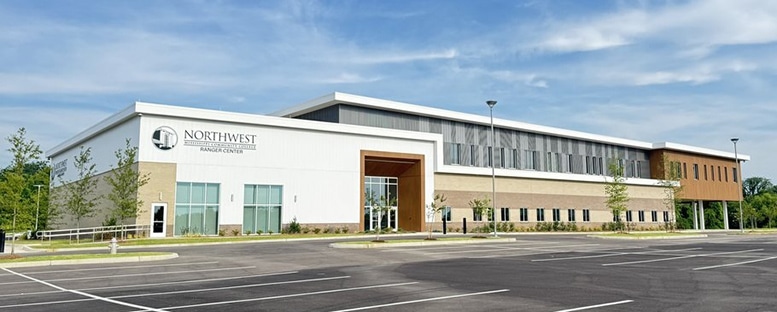
Meanwhile, NWCC’s Southaven campus will host a new associate degree nursing program at the recently opened Northwest Ranger Center. The $13 million, 42,000-square-foot facility is set to become a vital part of a refurbished regional healthcare ecosystem, Lafferty says.
“Students can start in the healthcare assistant program and get a job while continuing in their LPN program,” he says. “Our students start as an HCA or LPN before going into the RN program.”