The first phase of the Community College Innovation Challenge (CCIC) is underway with community college students around the country considering how to use science, technology, engineering or math (STEM) to solve real problems.
To participate in the competition, community college students must form two- to four-person teams that develop an innovative idea — no prototype is necessary, submit an essay and a 90-second video about their idea by April 3, and find a community college educator to serve as their mentor.
This article comes courtesy of the Internet Scout Research Group, which is based at the University of Wisconsin-Madison. It runs ATE Central, a free online portal and collection of materials highlighting the work of NSF’s ATE program.
The role of mentor is one that Ellen Hause, who organizes CCIC for the American Association of Community Colleges (AACC) in partnership with the National Science Foundation (NSF), hopes more educators in the Advanced Technological Education (ATE) community will seize.
“Mentoring a student team in the Community College Innovation Challenge is far more than supporting a competition — it is opening the door to a life-changing experience,” said Hause, AACC’s associate vice president for academic and student affairs. “Students develop confidence, communication, teamwork and problem-solving skills that employers consistently demand, while applying their technical knowledge to real-world challenges.”
CCIC is one of the initiatives funded by the Advancing STEM Technician Education & Innovation project grant from the ATE program. Hause is the principal investigator of that grant, which also supports mentoring, technical assistance and professional development through MentorLinks, ATE Future Leaders Fellows and the annual ATE Principal Investigators’ Conference.
Sharpening students’ foundational skills
All aspects of CCIC are structured to help students develop their communication, teamwork and entrepreneurial skills. The initiative is based on NSF’s Innovation Corps program, which provided support to help NSF-funded researchers translate their lab work into the marketplace, Hause said.
Mentors of past finalist teams praise CCIC as an excellent experience for them, too, particularly the Innovation Boot Camp in Washington, D.C., that culminates the second phase of the competition for 12 teams selected as finalists.
“One year we were in the initial round, but in many of the other years we were lucky enough to be able to go to Washington, and it’s been a fantastic experience for the three different mentors from our school who’ve been able to take students,” said P.J. Ricatto, a chemistry professor at Bergen Community College in New Jersey. He mentored the team that won CCIC in 2025 for its pop-up hydroponic farms made from recycled materials.
There is programming for the mentors during the boot camp, which is structured as a friendly competition where people learn from each other. Consequently, mentors gain “connections around the country and everybody is truly pulling for all the students to do well,” Ricatto said.
Educators and students interested in learning more about CCIC may also attend an application idea-vetting webinar on February 19. A CCIC judge and former student participant will be among the panelists. Students will have the opportunity to receive informal feedback on their ideas and ask questions. Registration is required.
Mentors’ perspectives
“I just love CCIC, and I think it is a fantastic opportunity for students,” said Nancy Woods. She is a professor of physics and mathematics and honors director at Des Moines Area Community College in Iowa. She has mentored two finalist teams and hopes another team of her students qualifies as a finalist this year.
“One of my passions is offering opportunities to students so that they can step outside of the typical,” said Nancy Woods, a professor of physics and mathematics and honors director at a community college in Iowa. “We did not win first, second or third place, but it was a fantastic experience and we learned where the flaws were in what we had envisioned” she said of the 2025 team’s smart phone app. The team members continue to work with a small business advisory agency to create a saleable product.
Woods sais the student participants have more confidence because of the Innovation Boot Camp.
“Two of the three that participated last year went to different competitions around the state of Iowa and they both were on winning teams,” she said, adding that CCIC participants “actually really learn valuable skills, valuable knowledge, valuable transformations of their own lives.”
Related article: CCIC opens doors for students
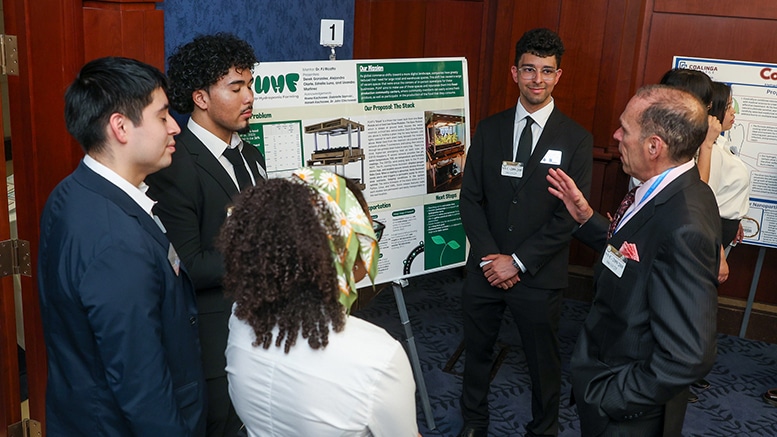
At the Innovation Boot Camp, students receive coaching to build their strategic communication and entrepreneurial skills. They practice those skills during a poster session where they engage with STEM leaders and congressional stakeholders. Then, at the end of the boot camp, the students pitch their ideas to a panel of industry professionals who select the top three teams. Each member of the first-place team receives $3,000, second-place team members each receive $2,000, and third-place team members each receive $1,000.
Think big now
LaTasha Starr, an engineering professor at Dallas College in Texas, thinks CCIC has taught all of her students that “they don’t have to wait until they get to university to then do big things.”
Since 2024, she has given her engineering students extra credit for preparing CCIC entries. The three best ideas from her students’ proposals have been entered into the CCIC. (Colleges may submit entries from up to three teams. However, only one team per college moves on to the finalist round.) In 2024, Dallas College won second place for its Autonomous Monitoring for Blaze Emergency Response (AMBER) project, and in 2025 the college’s team placed third for its Alerts VIA Detection and Ranging (AVIADAR) project.
Starr acknowledges that mentoring a CCIC team takes time for meetings with students, emails, Zoom informational sessions and some paperwork. “But if you’re really in the professorship to create the next generation of leaders and those change agents, this fits right along with that,” she said.
Bergen Community College’s Ricatto added: “In terms of a testimonial to why you should do it: All of us who’ve participated once keep coming back.”