

Geography Professor Jonathon “Jon” Little is enjoying a streak of good news for the geospatial information science technology (GIST) program at Monroe Community College (MCC).
He’s preparing to start his third ATE grant on October 1. Also, the New York college will soon receive state funds to upgrade its geographic information system lab for the students who choose in-person courses at the Rochester campus where GIST is the college’s fastest-growing program.
These recent developments are part of an upward trend that Little dates to 2015 when he received Mentor-Connect cohort mentoring to prepare his first Advanced Technological Education (ATE) grant proposal to the National Science Foundation (NSF). He said without Mentor-Connect mentors’ advice on how to “gel” his plans, he would still likely just have “these little ideas” about how to develop a stackable, hybrid GIST associate-degree program.
Mentor-Connect is an ATE project hosted by the South Carolina Advanced Technological Education Center at Florence-Darlington Technical College. The American Association of Community Colleges is a founding partner of Mentor-Connect.
Upcoming free webinar
To learn more about Mentor-Connect, register for a free webinar on September 24 (3 p.m. EST). The 60-minute session will focus on Mentor-Connect’s cohort mentoring for two-year college educators who have not previously had ATE grants.
Mentor-Connect Principal Investigator Pam Silvers and NSF program directors will explain the ATE program’s support for improvements of two-year colleges’ STEM technician education programs and Mentor-Connect’s resources to help faculty write competitive ATE proposals.
Applications for Mentor-Connect’s New-to-ATE cohort mentoring during 2026 are due November 7.
Securing more funding
The newest ATE project that Little will lead at MCC has received $679,505; these funds will enable the college’s GIST team to add artificial intelligence, more cloud-based skills and paid student internships.
Little was the principal investigator for two previous ATE grants awarded to MCC. The first grant for $199,838 helped to develop a 24-credit GIST certificate. The second grant for $467,639 supported the development of micro-credentials and the full associate of applied science degree that students could take entirely online or in person, or with a mix of in-person and online courses.
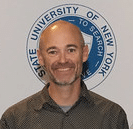
Little has also received a total of $209,199 in three supplemental NSF awards to fund student research in partnership with University of Maine professors and to develop a partnership with two German Applied Universities of Sciences.
Little learned this month that the State University of New York (SUNY) was sending MCC $180,000 to add high-end equipment to the college’s lab.
“Now with this SUNY funding, we’re hoping to expand more with in-person, but continue with online,” he said.
Other important support from SUNY is the designation of MCC’s GIST program as one that RECONNECT participants can use. SUNY RECONNECT provides free tuition for New Yorkers without college degrees between ages 25 and 55 to take courses in associate-degree programs that teach “in-demand skills for jobs in growing fields.”
Without Mentor-Connect, Little said, “I would not be where I am, professionally, and our GIS program would not be where it is right now at all.”
Leveraging his network
Monroe’s GIST program has 35 new students this fall and approximately 25 returning students. GIST alumni are working in western New York communities, and for international companies like L3Harris, Esri and Eagleview, according to Little.
Little, a former Fulbright specialist in geospatial technology, is using his connections and experiences to support his students. He has utilized his professional network to secure virtual internships for students, involving tasks such as analyzing satellite images and data to assess forest health in Maine and the prevalence of septoria and leaf rust in Kazakhstan’s wheat fields.
Little’s other accolades include the 2022 Dale P. Parnell Distinguished Faculty Award from the American Association of Community Colleges and the 2017 Lifetime Achievement in GIS award from the National Geospatial Technology Center of Excellence (GeoTech Center), an ATE center.
Praise for the mentors
Vince DiNoto, principal investigator and executive director of the GeoTech Center, served as Little’s first Mentor-Connect mentor. Osa Brand, senior personnel on the Mentor-Connect project, offered Little guidance on his second and third proposals.
“I can’t say enough about Vince and Osa, “ Little said. “They are amazing — super supportive. Not only supportive, but they’re also really knowledgeable about the grant-writing process. I learned so much about how to write a project [proposal]. … Without that, again, I would not have been successful.”
Little noted the GIST program is a team effort with his MCC colleagues, especially Wayne Howard (co-principal investigator and adjunct instructor), Heather Pierce (co-principal investigator and associate professor of geography) and geography professor Michael Boester. He added that the team has benefitted from the strong support of MCC leaders and staff at all levels of the college.