Community college presidents and senior leadership recently gathered for a deep dive into two hot-button issues for two-year colleges — the future of distance learning and artificial intelligence (AI).
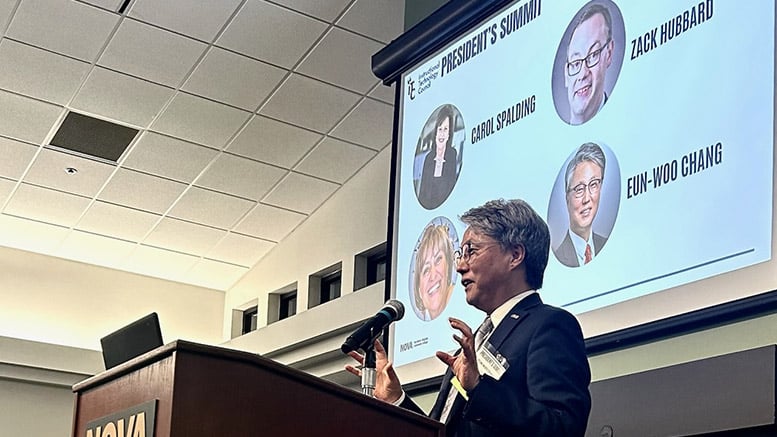
The leaders convened May 19-20 at Northern Virginia Community College (NOVA) to participate in a series of presentations, conversations and thought sessions during the inaugural President’s Summit, which was co-hosted by the Instructional Technology Council, an affiliated council of the American Association of Community Colleges (AACC).
Online classes have been disrupting enrollments for more than 25 years and continue to be the primary source for enrollment growth. This modality of instruction offers the best instructional method to serve the growing number of active adult learners in a rapidly changing workplace, as well as dual-credit enrollments for high school students. College leadership needs to better understand how to support and expand online courses and degrees.
AI, on the other hand, presents a different set of challenges and opportunities for college leadership. In the two years since Generative AI launched, corresponding emerging issues include ethical use, privacy, access and cost. Leadership needs to learn how to manage, prioritize and finance this new technology while reassuring faculty that academic integrity will be maintained.
Addressing key factors
The ITC President’s Summit organizers (Eun-Woo Chaing, NOVA’s vice president of academic affairs/chief academic officer; Carol Spalding, president of North Carolina’s Rowan-Cabarrus Community College; and Carlos Morales, campus president of Tarrant County College‘s TCC Connect Campus (Texas) developed a program tailored for community college senior leadership that would:
- Position online education and AI as central pillars of equitable, accessible and future ready learning
- Surface blind spots and structural barriers preventing community colleges from adapting to digital disruption
- Facilitate peer exchange on what it takes to lead with clarity and courage in this rapidly changing landscape
The program was specifically designed to address what senior leadership needed to more effectively manage online learning and Generative AI. Featured speakers included representatives from the Changing Landscape of Online Education Project., Quality Matters and Microsoft, as well as EDUCAUSE, AACC and Achieving the Dream. Scott Van Pelt, co-author of The Great Upheaval: Higher Education’s Past, Present and Uncertain Future, was the keynote speaker.
The summit also included breakout sessions that focused on a provocation as well as recommendations to address each provocation. A sample from each session:
What’s Holding Us Back?
If community colleges are built for innovation, why are we playing it safe with AI and online learning?
Themes of discussion
- Many faculty feel ill-equipped or fearful of adopting new technologies, especially AI, due to a lack of training and a perceived threat to their pedagogical integrity.
- Without coordinated leadership, individual enthusiasm can get lost in institutional inertia, widening the gap between early adopters and the broader faculty body.
Recommendations
- Establish centralized systems to vet and support the use of AI and digital tools, ensuring safety, equity, and alignment with strategic goals.
- Normalize AI and digital literacy as institutional competencies, providing faculty with ongoing training and peer support communities.
Students Are Living A Different Reality
Students have embraced the flexibility and immediacy of modern learning tools – while many of our faculty have not.
Themes of discussion
- Many faculty lack exposure to the digital tools students use daily and feel unprepared to replicate or evaluate their academic applications.
- Professional development is too often generic, optional or under-resourced – leaving faculty to navigate change in isolation.
Recommendations
- Launch comprehensive, faculty-centered AI and digital pedagogy programs that are discipline-specific and strengths-based.
- Reframe faculty development as professional empowerment, not compliance – linking it to institutional mission and student success.
Managing Disruption
Online learning isn’t a side initiative – it’s the future.
Themes of discussion
- Online and hybrid modalities are often under-resourced or treated as supplemental despite evidence of student preference and success.
- Institutions need to stop designing for classrooms and start designing for learners – whether they are in a building, at home or work.
Recommendations
- Reallocate funding to prioritize digital infrastructure, AI-integrated systems and scalable learning platforms.
- Center flexibility and relevance in all planning efforts – design for the student of today and the economy of tomorrow.
Key take-aways
The ITC Presidents Summit concluded by identifying several strategic action items so as to incorporate what was learned during the summit:
- Make online learning a strategic priority of your college.
- Create AI working groups.
- Create a culture for ongoing training.
- Include student voices – after all, our learners are focus of 21st century community colleges.
- The college needs to work with faculty to develop a college-wide policy on AI. Leaving the legitimacy question of AI for faculty to interpret confuses students. The college needs to design our response with the students in the forefront. They will be called upon to apply their skills to address accuracy and ethics in the years ahead. Our faculty can help them manage the future now.
For more information about this summit or future summits, please contact the Instructional Technology Council.