Recent federal policies have affected populations that community colleges have long served: international and undocumented students. College leaders say they are continuing to serve these students and are speaking out about the value they add to their communities.
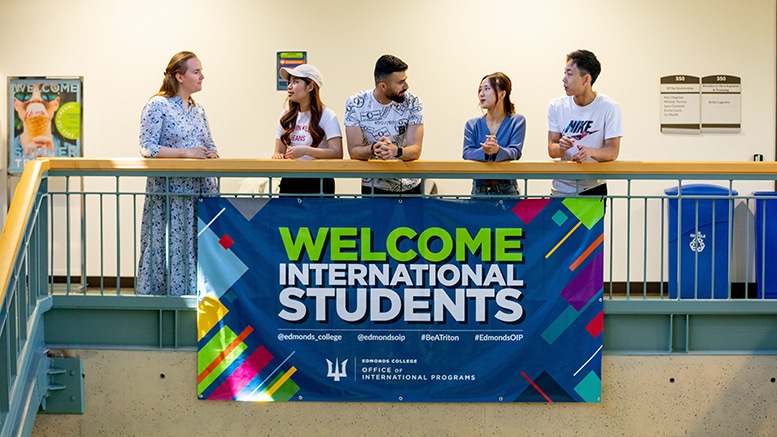
Washington’s Edmonds College has been a leader in the state in international student recruitment. During the 2018-2019 academic year, Edmonds had enrolled about 1,600 international students from more than 55 countries.
Unsurprisingly, that number declined sharply during Covid, to fewer than 800 students. And it hasn’t completely bounced back. This past academic year, Edmonds welcomed about 825 international students.
“Because of the environment we’re in, we’re not rebounding as we should,” says Edmonds President Amit Singh.
Changes to the F-1 visa policies and processing have led to higher rejection rate for student visa applicants. According to a 2026 report from international education firm Shorelight, denials reached 35% worldwide in 2025. Most of those refusals were concentrated in Africa, the Middle East and South Asia.
Processing times for visa applications also are causing issues. Singh observes that, due to slow processing times, prospective students may miss the fall quarter, then have to wait months before starting at Edmonds – if they even get approved.
Singh says the intent of the policy changes may be good, but it’s having negative impacts. Still, “I’m optimistic things will turn around – they always do,” he says.
In the meantime, Singh continues to try to recruit new international students. He visits other countries (he was in Japan recently) to speak with partner agencies and parents. There’s a “long lag time” with international student recruitment, he says, but he knows his efforts will pay off in a year or two.
Singh himself came to the United States as an international student on an F-1 visa, so he has made international student recruitment a priority. The college has on-campus housing as well as a homestay program, and its location close to Seattle is attractive, too. Also of importance – particularly to the parents Singh speaks with – Edmonds is affordable, safe and has a 100% transfer success rate for those interested in continuing toward a four-year degree.
“We’ve built a good brand,” Singh says.
And the campus community benefits from international students, too.
“What we learn from them is so valuable,” he says. “The classroom is so enriched in terms of their participation. That’s a loss if we don’t have that.”
Singh adds, “They make our campus stronger and our democracy stronger.”
Speaking out for Dreamers
Northern Essex Community College (NECC) is located in Lawrence, Massachusetts, which is known as “The Immigrant City,” says NECC President Lane Glenn.
NECC was designated a Hispanic-Serving Institution in 2001, and now about half of its enrolled students are Hispanic. While most of those students are not immigrants, many live in “mixed status” households.
The community is “vigilant,” Glenn says, especially after a U.S. Immigration and Customs Enforcement (ICE) surge in Maine in January.
Enrollment at NECC hasn’t been affected yet over fears of deportation, helped in part by statewide free college programs as well as the state’s tuition equity bill, which allows undocumented and non-citizen students to receive financial aid. Glenn doesn’t expect a dramatic drop-off in enrollment anytime soon as “undocumented students aren’t a giant part of our population,” he says, “but they’re an important part of our population.”
He adds, “They’re part of the fabric of our community.”
What concerns Glenn is the current “slow-walking” of Deferred Action for Childhood Arrivals (DACA) renewal applications. There are six- to 10-month processing delays, meaning “Dreamers” can fall out of status and be arrested before their paperwork is processed. The American Association of Community Colleges (AACC) in May joined with the American Council on Education and other higher education associations to formally call attention to these pronounced processing delays.
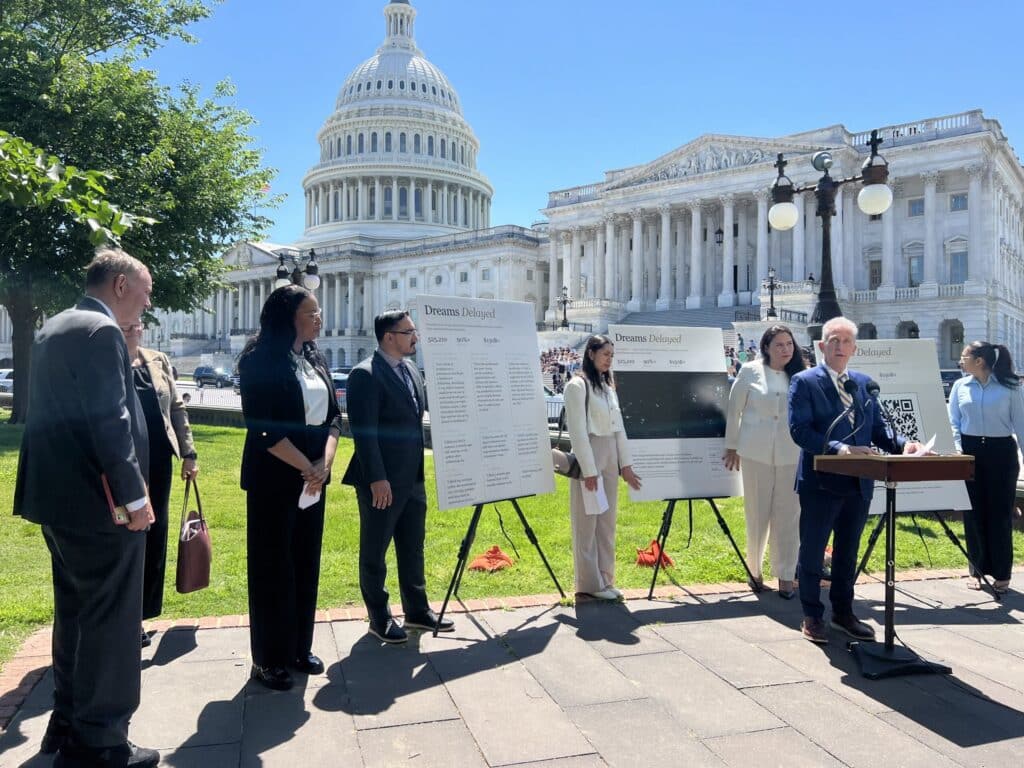
Glenn is a member of the Presidents’ Alliance on Higher Education & Immigration Steering Committee. In May, he was in Washington, D.C., with U.S. senators, students, educators and business leaders to raise awareness of threats facing Dreamers.
“Our colleges, communities and economy all need Dreamers everywhere to succeed. Our students should not have to keep living from court decision to court decision or policy change to policy change,” Glenn said during a press conference on Capitol Hill. “We need stability and a path forward so students can learn without fear, researchers can pursue their innovative ideas and our academic communities can thrive.”
Los Angeles Community College District Chancellor Alberto J. Román migrated with his family to the United States from Mexico when he was a child. He told Community College Daily that Dreamers “are some of the most determined, hardworking students I encounter across our nine colleges.”
Federal policy shifts have caused anxiety for undocumented students and mixed-status families across the district’s nine colleges.
“We’ve seen students hesitate to come to campus or ask for help, even when that help has nothing to do with their immigration status,” Román says. In response, the colleges have leaned further into providing student-centered support. “Our responsibility to educate doesn’t change based on someone’s background or country of origin.”
Protecting in-state tuition
Some states also have rescinded in-state tuition policies for undocumented students. At least 20 states and the District of Columbia allow undocumented students to pay in-state tuition rates at public colleges and universities, according to the Higher Ed Immigration Portal. Texas was one of those states after passing the Texas Dream Act in 2001. Last year, a federal judge blocked the law.
Austin Community College (ACC), along with students and immigrant-rights organizations, are fighting to restore the act.
When asked for more information, ACC provided this statement from its board of trustees: “The ACC Board of Trustees remains focused on what is best for our students and community. As an elected arm of the College, the Board is seeking clear guidance and an opportunity to engage in the discussion to better understand what the law now means and how it will impact students. The College respects the legal process and will continue to follow the proceedings as they move forward.”
Meanwhile, California continues to allow eligible undocumented students, including DACA recipients, to pay in-state tuition at public colleges and universities. LACCD’s Román says access to in-state tuition is vital to many undocumented students.
“If that access were ever taken away, the cost of attending would jump dramatically for thousands of LACCD students, pricing out young people who grew up in Los Angeles, graduated from our local high schools, and simply want the same chance at a degree as their peers,” he says. “Affordability is what makes community college community college; without it, we’d be turning away the very students our colleges were built to serve.”