
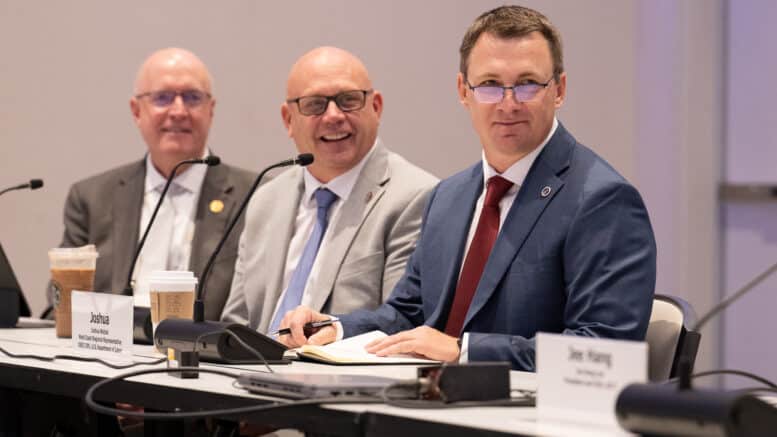
SEATTLE — U.S. Department of Labor (DOL) officials came to the annual conference of the American Association of Community Colleges (AACC) this weekend mainly to listen, with a particular interest in learning about innovations and ideas to help address workforce challenges.
Troy Selberg, director of DOL’s workforce initiatives, and Joshua Wetzel, West Coast regional representative in DOL’s Office of the Secretary/Office of Public Liaison, heard from AACC board members after giving a brief overview of the Trump administration’s plans for workforce development. At the center of that effort is the America’s Talent Strategy, the administration’s blueprint that focuses on five key areas. The officials also noted other efforts of the administration to improve efficiencies, such as inter-agency partnerships, new funding opportunities like Workforce Pell and the expansion of registered apprenticeships.
The two also emphasized postsecondary paths to good-paying jobs other than four-year institutions, adding that in too many cases, students complete costly baccalaureate degrees that don’t align with career expectations. Meanwhile, retirements are fueling a growing worker shortage in many fields.
“Two million people are sitting on the sidelines ready to work, but they are not,” Selberg said. “There’s a majority of the workforce that was educated in disciplines that don’t apply, and they need to come back to the community colleges, they need to get re-educated and fill those skills gaps that we have today.”
After noting the important role that community colleges play in helping people to connect with the needed education and training for many of those jobs, the DOL officials went into listening mode.
“No one knows better than the people sitting in this room about the communities you serve, about the stakeholders and business leaders in that community,” Selberg told the board.
Funding among top concerns
Top-of-mind issues of AACC board members included: federal funding (particularly for the TRIO and Child Care Access Means Parents in School programs); reducing red tape for grants and registered apprenticeship programs; and better alignment among federal agencies on workforce definitions, standards and data. The leaders also cited rethinking adult education programs; scaling competency-based models; increasing paid work-based learning opportunities; and paying attention to different needs in different regions.
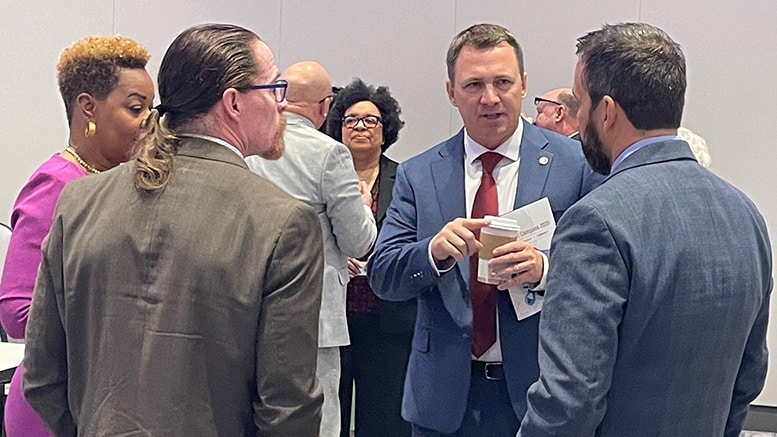
AACC President and CEO DeRionne Pollard noted that community colleges are the sector in higher education that can grow the skilled workforce along with its partners.
“This is our jam. We know this better than any other sector in this country. And if you want to see movement, we’re the space that can do that for you,” Pollard told the DOL officials.
However, more resources are needed to do the work. Pollard echoed the comments of several board members that community colleges, particularly those in rural areas, continue to be funded at lower levels than public four-year counterparts, even though two-year colleges serve about 40% of the nation’s undergraduates. She said in one state where she worked, community colleges received 25 cents in public support for each dollar that universities received.
“That’s embarrassing and wholly inappropriate for the work that we do,” Pollard said.
Salberg and Wetzel, who planned to attend the conference and talk with AACC members, added that DOL also wants to hold regional conversations on workforce development that include K-12 systems, community colleges and stakeholders.