SEATTLE — The nation’s leading association for community colleges is embarking on a reset that will guide its work over the next decade.
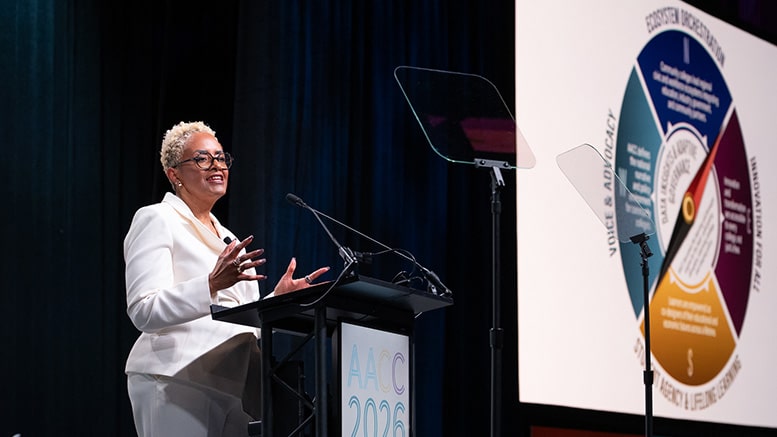
On Saturday night at the opening plenary of the American Association of Community Colleges (AACC) annual convention, AACC President and CEO DeRionne Pollard unveiled the framework for the association’s work, called the Strategic Compass 2035. Pollard said the structure is not a traditional strategic plan, but rather a navigation system to transform an ecosystem in which community colleges are crucial to civic and workforce infrastructures.
“The compass will guide us, organize our work; serve as a touchstone when we need clarity and coordination,” Pollard told the 1,700 convention attendees, who comprised presidents and other college leaders, business and industry representatives, federal government officials and other stakeholders.
Pollard, a former president at two community colleges and a university, has spent her first six months at AACC listening to college leaders and stakeholders, and mulling ideas on a new direction for the association to help its members navigate a rapidly changing world. She studied the findings of AACC’s “Resilient by Design” report released at the beginning of her presidency, which outlined the status of the sector and its role in the future. Pollard’s process also included a look back to the sector’s roots. She studied the 1947 Truman Commission report, from which America’s community colleges emerged, and used it as a springboard for a new vision.
From there emerged the Strategic Compass 2035, with a revamped purpose for the association: “AACC strengthens and mobilizes America’s community colleges as engines of equitable opportunity, economic mobility and civic vitality. This purpose is the gravitational grounding of the Compass.”
Five anchors
At the plenary, Pollard explained how the Compass — comprised of five “anchors” — is designed to position the association and member colleges to focus on areas that will support their missions. Although there is overlap among the areas, a “needle” provides flexibility for the association to address immediate needs.
The anchor at the center of the compass is data insights and adaptive governance, with the goal of AACC becoming the “learning and foresight engine of the field, forecasting changes, informing strategy and shaping policy,” according to an outline shared at the opening session.
“For years, many of us have been awash in data,” Pollard said. “Much of it is important, but some of it doesn’t produce the information or understanding we need. And some of it doesn’t tell the real story of our impact very well, especially beyond our walls.”
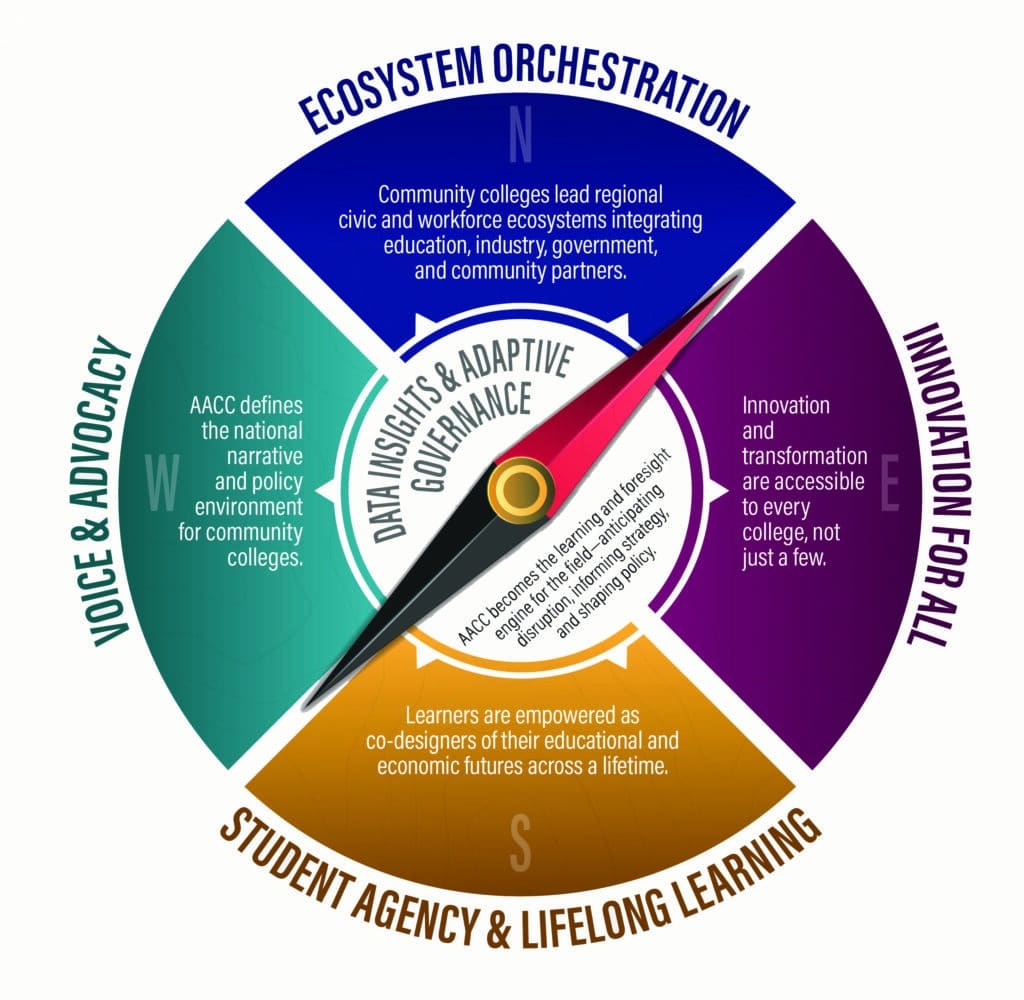
The second element is ecosystem orchestration, where community colleges lead regional civic and workforce ecosystems. It will be important for colleges to scan the landscape and embrace organizations that may not have been partners previously.
“Just about every important enterprise-wide goal you can imagine is strengthened by asking ‘Who’s missing from this table?'” Pollard said. “And when you know the answer, bring them into the ecosystem. In my experiences as a president, I found this to be one of the most powerful tools in the institutional toolbox.”
The third element is innovation for all, which requires disconnecting from historical meritocracy in higher education.
“We are the sector that is poised most powerfully to have this impact, and we must take the lead in securing it,” Pollard said.
Student agency and lifelong learning is the fourth element. It focuses on empowering learners as co-designers of their educational and economic futures. Colleges will play a key role in providing information and resources to help students make their choices, Pollard said.
“How many eligible students have come across your path who are unwilling to fill out the FAFSA because it’s cumbersome? Or are unaware of a scholarship that would allow them to reduce their work hours?” Pollard said. “Student voices must be embedded in these conversations from the beginning – they can lead us to the right pathways to their peers.”
The final element is voice and advocacy, with AACC defining the national narrative and policy environment for community colleges.
“Telling your stories – our students’ stories – is vital so that Pell grants keep pace with inflation, so that investments in grants to our colleges continue, so that Workforce Pell is successful, so that our interests in accreditation are heard, and much more,” Pollard said.
Strategic bets
The compass and the work it will include are complex and may seem overwhelming, Pollard said. She offered “strategic bets,” which provide action items for the association to reach its goals. They include:
- Build the nation’s most trusted, timely and actionable intelligence platform for community colleges.
- Shape the talent and work ecosystems of the future by aligning credentials, work-based learning, employer partnerships and policy coordination.
- Redesign leadership formation offerings for presidents to meet the complexities of institutional needs with greater coherence and clarity of purpose.
- Enrich student agency and life-long learning through robust instructional experiences, timely career connections and best practices.
- Showcase community colleges as creators of civic infrastructure, closely connected to community prosperity and robust democracy.
Pollard emphasized that the work is essential for community colleges to fulfill their missions and serve their communities.
“This is not a moment for hesitation,” she said. “This is a moment for leadership.”