
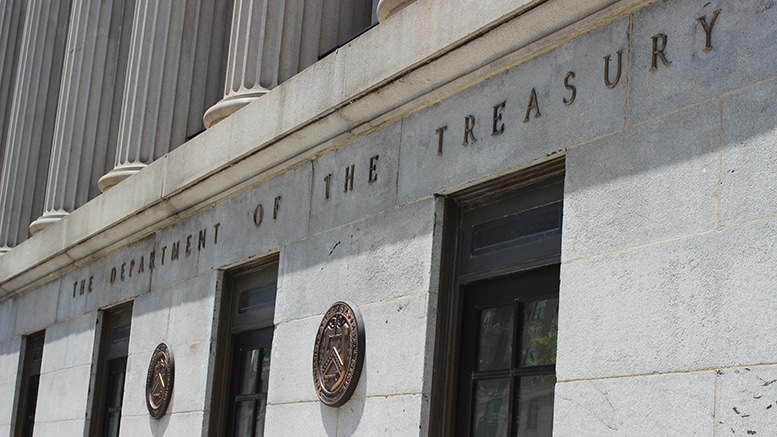
The Trump administration on Thursday continued with its effort to dismantle the U.S. Education Department (ED) by announcing that it would gradually transfer parts of the agency’s $1.7-trillion student loan portfolio to the U.S. Treasury Department.
The transfer will be phased in, beginning with Treasury assuming responsibility for handling defaulted student loans. ED said the move will help better manage the student loan program, which officials said was particularly mismanaged under the Biden administration, noting that fewer than 40% of borrowers are in repayment and almost one quarter of borrowers are in default.
“Student loan debt is roughly twice the size of all American university endowments combined and is larger than either our nation’s cumulative credit card debt or cumulative auto debt. ED was never intended to operate what would be the fifth-largest commercial bank in the United States, distributing over $100 billion each year in Federal student loans and grants,” the department said in a release.
The effort will be similar to an interagency agency agreement ED has with the Labor Department (DOL) for DOL to operate certain programs, including career and technical education, adult education and certain postsecondary programs such as TRIO. Leveraging Treasury’s expertise in finance and economic policy should help manage the loan program more effectively and efficiently, ED officials said.
A phased transition
Under the new agreement, Treasury will first collect defaulted student loans and provide operational support to ED’s efforts to return borrowers to repayment. In later phases, Treasury will work to provide operational support for non-defaulted student loan debt — “to the extent practicable and permitted by law” — while also “seeking opportunities to provide operational support to other functions at ED’s Office of Federal Student Aid.”
ED added that all federal student aid systems, such as the Free Application for Federal Student Aid (FAFSA), Common Origination and Disbursement System and the National Student Loan Data System, will remain in place and will continue to be administered in accordance with applicable statutory requirements. ED’s Office of Federal Student Aid (FSA), in conjunction with Treasury, will continue to communicate with colleges and universities through the FSA Knowledge Center, according to an ED fact sheet.
ED noted the two agencies already work together on areas related to student aid. For example, Treasury disburses funds for federal student loans; ED uses Treasury’s federal tax information data systems for income verification for the FAFSA and income-driven repayment plans; and ED has worked with Treasury on employment data for its forthcoming accountability framework.
The agencies did not announce a timeline for the transition, but added they plan to keep students, parents, borrowers, institutions and vendors informed of their plans and timelines and address any questions.
The announcement comes the same week that the House Education and Workforce Committee moved legislation to help ED address the growth in fraudulent student aid applications. Last week, the General Accountability Office released a report raising concerns about oversight of loan services providers in the wake of massive staff cuts at ED, particularly in FSA.
Red flags
Congressional Democrats and other student advocate organizations criticized the ED/Treasury plan, expressing concerns that it will confuse many students and families. They also argued that student borrowers who need assistance the most — those in default — will have limited access to subject-matter experts at ED.
“It’s unclear if the Trump Administration’s goal is to intentionally create chaos and confusion for these borrowers, many of whom are already in dire financial straits,” said Rep. Bobby Scott (D-Virginia), ranking member on the House Education and Workforce Committee.
The National Consumer Law Center also expressed concerns about services for borrowers.
“Moving default collections and student loan servicing to the Treasury raises a new set of obstacles and uncertainty with no plan in place to resolve them,” it said in a release. “The Department of Education hasn’t answered the question of how it will educate Treasury staff on borrowers’ rights under the Higher Education Act or how it will ensure clear communications with borrowers during this confusing transition.”