
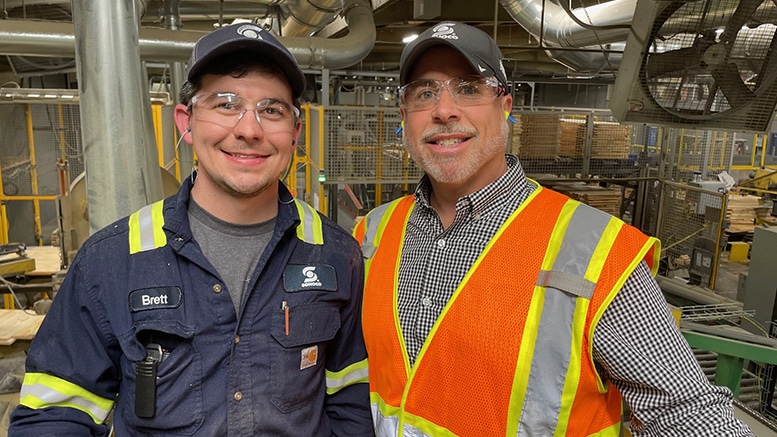
Brett Terry is a famous man at the 28,000-employee multinational packaging giant Sonoco after being featured as a 2025 Sonoco Champion Award winner in a video introduced by Sonoco’s corporate CEO, Howard Coker. Terry, now 28, has worked his way up the ranks at the 300-person Sonoco Wood Reels plant in Hartselle, Alabama. He now earns “in the low forties” per hour as a senior technical leader.
Terry credits many of the skills he has learned to a maintenance degree apprenticeship program offered by his alma mater, Calhoun Community College (Calhoun), in partnership with Sonoco. The program saw him graduate in 2018 with a joint associate degree in applied science and a certificate of completion for a two-year apprenticeship at Sonoco.
“The whole commingling of education and work was very valuable,” Terry says. “Everything that they taught in school was relevant to work at my actual plant. It was just such an interesting college experience because work and education were so intertwined and in sync with each other.”
With a Trump administration goal to register more than one million new active apprentices across the U.S. to prepare workers for high-paying jobs, degree apprenticeship programs such as Calhoun’s are coming into heightened focus as an earn-and-learn model that combines two things of vital importance to students: extensive real-world employment experience that yields compensation that defrays educational expenses and a degree, seen by many as the guarantor of higher long-term earnings prospects and career advancement.
However, degree apprenticeships are not available everywhere; they tend to be concentrated in certain states and certain fields. They also require substantial commitment from community colleges, employers and students alike.
Gauging the landscape
In January, think tank New America released a report on degree apprenticeships, which measured programs integrating a registered apprenticeship with an associate, bachelor’s or master’s degree. The study mapped their prevalence and variation across the country for the first time.
Conducted last summer, the study found nearly 350 institutions of higher education in 49 states and the District of Columbia offered close to 600 degree apprenticeship opportunities that provided career preparation for 91 different occupations. Among public and private nonprofit institutions of higher education that award associate degrees in occupational areas in 2022-23, about 12% offered at least one associate degree apprenticeship opportunity, according the report.
However, degree apprenticeship programs were concentrated in a small number of fields and states, the study found. More than three-quarters of the degree apprenticeship opportunities were in just five occupational groups, and nearly one-third of them were in just one category: educational instruction and library occupations, including occupations like K–12 teachers and preschool teachers.
David Lugo, plant manager of the Sonoco Wood Reels plant — and Terry’s boss — says Sonoco’s participation in degree apprenticeship programs began with Calhoun just prior to Terry joining the program in 2013. On average, seven to 10 apprentices now work at the plant each year. Of those, about two typically go on to join Sonoco full-time, while many others are hired by similar companies in the industry.
Lugo says that he closely collaborates with Calhoun faculty to design curriculum that is relevant to what students will do in Sonoco and to students’ performance in both the classroom and at the plant.
“The benefit of these degree apprenticeship programs is the structure itself,” Lugo says. “It’s a proven structure. The curriculum matches the competencies required for the apprenticeship by the state of Alabama. What Calhoun has done really well is make sure the curriculum aligns perfectly with the competencies required to complete the apprenticeship — so when someone finishes, you know they’re proficient in those skills and ready to be signed off as a trained apprentice.”
Scaling up
Ivy Tech Community College, the statewide community college system of Indiana, demonstrates just how big such programs have already grown in the trades. Ivy Tech’s degree apprenticeship program, established in 1994 and featuring a partnership with the Indiana Building Trades Joint Apprenticeship Training Committees (JATCs), has grown from four pilot programs with 800 students, to 12,000 building trade apprentices across 19 campuses, says Teresa Hess, Ivy Tech’s assistant vice president of apprenticeships and work-based learning, adding that it includes 12 trades and 17 academic programs.
Community colleges are strong players for these programs given that two-thirds of the degree apprenticeship opportunities New America identified awarded degrees at the associate degree level, in contrast to 29% awarding bachelor’s degrees and 4% awarding master’s degrees, and given that degree apprenticeships are offered nearly exclusively by public institutions.
The report found that degree apprenticeships featuring registered apprenticeships were concentrated in certain states, such as Alabama, Illinois and North Carolina. In such states, the prevalence often reflected a supportive policy environment, the availability of public funding to support apprenticeships, and the influence of local Europe-based companies that view apprenticeship as an important talent development strategy.
The challenges
Despite such advantages, there are several reasons why they are not available in all states and offered for a wider variety of degree programs. From employers’ point of view, they require buy-in to a long-term arrangement and mentors, who must offer some of their scarce time to support programs. They also tend to be better fits for professions such as nursing and teaching that have clear clinical or experiential requirements and workforce shortages, which garner the greatest support to sustain such programs.
There are also challenges for the students, including commitment level, given such programs require a heavy workload in addition to schoolwork.
Apprenticeships are also time-intensive for the higher education institution, which must either administer the program or find another organization to do so, and for participating employers that must provide a designated mentor for each apprentice.
Big plans in San Antonio, Boston
In Texas, the Alamo College District, which has 90,000 students at five colleges and eight training centers in the greater San Antonio, sponsors a variety of degree apprenticeship programs, which are predominantly in the trades, such as plumbing, electrical, construction and manufacturing, says Chancllor Mike Flores. The district also uses the Texas Federation for Advanced Manufacturing Education model, including three days of classroom training and two days on-site at manufacturers like Toyota or Caterpillar.
Flores says that Alamo Colleges aims to scale up apprenticeships, including in nursing and education, through programs for high school students.
“Participation right now is 50 to 75 students, but our goal is to really scale up into the hundreds and then into the thousands,” Flores says. “Because of the current environment and high level of interest from both the state and federal government and private sector partners, we’re looking at enhancing the number of apprenticeships, and, in particular, degree apprenticeships.”
Related article: Massachusetts to expand degree apprenticeships
In Boston, Bunker Hill Community College last fall launched its first cohort of an apprenticeship program for education professionals currently working in the both primary/elementary and secondary school employees, says Wissal Nouchrif, BHCC’s interim dean of professional studies. The initial cohort of eight students — employed at Everett and Chelsea public schools in paraprofessional positions such as teachers’ assistants and other professions that help individual students with a variety of learning and behavioral services — are in the process of getting an associate degree in education with plans to transfer to a four-year institution to get a bachelor’s degree and become a teacher, Nouchrif says.
A second cohort planned for this fall will seek to expand the number of student apprentices and will target new public school systems. Two additional cohorts in additional academic fields, for surgical tech and social work, will also start in the fall, she adds.