“Go to QCC for free!” boasts the website for Quinsigamond Community College (QCC), one of 15 public two-year institutions in Massachusetts. This clarion call has grown QCC’s enrollment from 6,491 in 2022 — the year before the MassReconnect free-tuition program launched — to 8,715 during the 2025 academic year.
The 34% increase is partly due to the program, which originally covered tuition and fees for non-degree holders aged 25 and up, as well as to the efforts of the college’s enrollment teams. In fall 2024, an expanded MassEducate program was introduced, serving all Massachusetts residents who do not already have a bachelor’s degree.
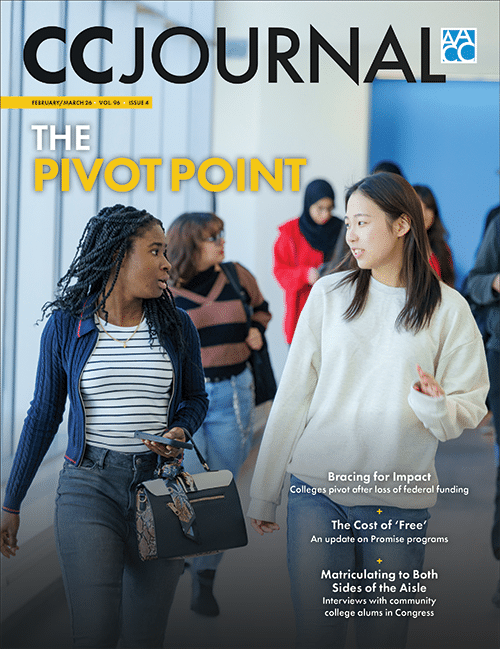
This article is an excerpt from the new issue of the Community College Journal, the bimonthly magazine of the American Association of Community Colleges.
Both “last-dollar” efforts have removed attendance barriers for first-time students and reengaged stop-outs eager to complete their degrees, notes QCC President Luis Pedraja.
“Many of our students are working adults with families, a situation which might normally be insurmountable for attending school,” Pedraja says. “We’ve taken that barrier away and made it possible for them to get an education. For us, we want to get out the message that you can afford college.”
The funding landscape
Free tuition comes at a time of uncertain federal funding for community colleges. An environment of declining state and local backing is further destabilized by shifting federal mandates on student loan forgiveness, DEI initiatives and Title IX protections.
Funding per full-time equivalent student at two-year colleges dropped 3% between 2023 and 2024, according to College Planners of America, an Illinois-based company that provides guidance to families around the college admissions process. Even in states with lower tuition fees, learners face significant strain from rising housing, food, childcare and transportation costs.
The average tuition in Massachusetts for in-state two-year students is about $6,000-$7,000 annually, a cost covered by MassEducate. Gov. Maura Healey signed a $58 billion state budget bill in 2024, allocating $117 million to create the initiative. Generally, policymakers across the political spectrum support efforts like those in Massachusetts — what’s needed now is to improve outreach and make a complicated system more understandable.
“We heard from a student who never even completed a FAFSA until MassReconnect,” says Nate Mackinnon, executive director of the Massachusetts Association of Community Colleges. “She didn’t get SNAP because she made too much money and had no idea she was eligible for financial aid. So, the messaging was changed, and it’s working. We’re reaching the people we want to reach and not shifting to students who’d already be going to a four-year institution. These programs are impacting people who wouldn’t go anywhere for college.”
Thinking bigger
Mackinnon, who helped develop both MassReconnect and MassEducate, says MassReconnect was directly modeled after Michigan Reconnect, which similarly offers last-dollar scholarships to residents 25 and older.
Massachusetts community colleges saw a 9% increase in enrollment in fall 2023 after the launch of MassReconnect. A Fair Share surtax, levied on households earning over $1 million annually, allocated $1.28 billion to public transportation and education, including funding for MassEducate. The investment has resulted in universal tuition-free community college and up to $1,200 yearly stipends for books, supplies and other expenses.
“People’s thinking got bigger,” Mackinnon says. “Let’s start with MassReconnect, because it’s a smaller number of students. Then we can talk about implementing a plan for universal free community college. Now we have MassReconnect and MassEducate funded as two different line items, but all of our marketing is that this is free community college. That’s very intentional, because we don’t want students wondering if they’re eligible for one or both of those things.”
Both programs prioritize access over completion while offering financial assistance to undergraduate students, whether enrolled full- or part-time. Applicants are only required to complete a FAFSA and meet minimum enrollment requirements, without the need to finish a training program or meet with a mentor.
Ultimately, program proponents did not want participants to jump through too many hoops, says Mackinnon.
“We’ve got low-income students and ESL students who don’t understand the nuances of going to college, and they just give up,” he says. “So let’s get them in the door with these programs.”
Beyond financial barriers
Tuition isn’t the only hurdle to successful outcomes, as students need adequate support systems to graduate, observers say. Pedraja of QCC highlights capacity building as a major challenge, specifically the need for more hires in faculty, admissions and financial aid.
“That type of work takes time, especially at community colleges where you have part-time students who need to understand FAFSA,” Pedraja says. “This past year, we added a counselor to the team and have faculty who are pitching in to help with the advising process. We want to bring in people with the basic training to ensure students have all the proper documentation. The handoff between admissions and advising should be smooth with every step covered.”