The new Workforce Pell program is set to start in less than five months. But Nicholas Kent, under secretary at the U.S. Education Department (ED), isn’t worried about it. He’s confident the department will have the program ready to roll by then.
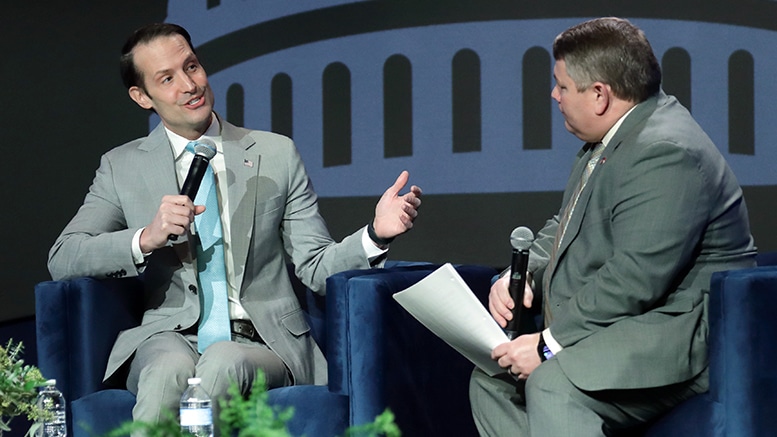
The question is whether states, colleges and other stakeholders will be ready by July 1 as well, Kent said at a session Monday during the Community College Legislative Summit in Washington, D.C., an annual advocacy event held by the Association of Community College Trustees with the American Association of Community Colleges (AACC).
Workforce Pell is scheduled to begin July 1, as set by the budget reconciliation legislation that created the program last summer. Since then, ED has been on a tight timeline, with drafting proposed rules, steering consensus with stakeholders during negotiated rulemaking in December and now crafting proposed regulations based on those negotiations, which the department is expected to release soon for public comment.
But Kent said ED is used to the pace since Donald Trump started his second term in office last year, observing that it has taken on similar efforts with other recent education programs and policies.
“It is a priority for the administration,” he said, adding: “Over the course of the last six or seven months, we have met every single timeline that we have set out to achieve.”
More on Pell
John Enamait, president of Stanly Community College in North Carolina and AACC board chair-elect, led the discussion with Kent, who assumed his post six months ago. Enamait asked the under secretary about the administration’s plans for the overall Pell program, particularly funding and fiscal stability. Kent cited that the revamped Free Application for Federal Student Aid (FAFSA) has, in part, yielded an increase in federal aid applicants.
Kent noted that Congress did not appropriate new funding to support Workforce Pell. And because it’s a new program, he said, it’s uncertain how students will react. For example, will more students engage in higher education, who would have otherwise not gone on to college? Or will students who were considering a four-year degree instead opt for a short-term program?
“We don’t know what the behavioral change will be, which makes costing this out a little bit of an imperfect science at the very beginning,” he said.
That means ED will have to make some hard decisions, Kent continued.
“We want to work with Congress to identify areas where we can cut back and then areas where we can further support,” he said, noting there is strong support for both Pell and Workforce Pell.
Shout out for FAFSA
Kent also noted the administration’s efforts to improve FAFSA, citing the Biden administration’s botched launch of the revamped form and process. Not only was the FAFSA release on time for this cycle, it was launched earlier than usual, he said. The latest figures show ED has received 17 million completed FAFSAs, and expects to reach 20 million soon, he said.
That’s good news, but it also means more strain on the system and higher costs.
“We are going to have to pay very close attention to the change that will happen with the Pell Grant program over the next couple of years,” Kent said.
Enamait did note that while community colleges are the most affordable postsecondary sector, education is still out of reach for many students, who depend more on Pell grants than students at four-year institutions. Kent replied that, as a former Pell recipient who attended a dual-enrollment program at a local community college in West Virginia, he understands the challenges for students. While affordability and access are important, more can be done to improve higher education through support services, Kent said. Community colleges also historically face challenges with student completion and gainful employment for some programs, he said.
“Money is not always the solution,” he said.
Deeper dive into Interagency agreements
Enamait also asked Kent for more details about the administration’s efforts to parse out education programs from ED to other agencies. The under secretary said the thinking behind it starts with three questions:
- What does ED do that it shouldn’t.
- What is more appropriate for states to take on, especially in K-12.
- If a program must stay at the federal level, which agency would best handle the work.
The administration concluded that shifting the administration of career and technical education (CTE) and adult education programs to the Department of Labor (DOL) made sense given the DOL’s connection to workforce development. Moving ED employees in those programs to DOL would yield better efficiencies, better program management and streamline reporting, he said.
Kent acknowledged there are always “little hiccups” with mergers, but, overall, it’s been a smooth transition, adding ED is not seeing changes in funding drawdowns for CTE.
Some community colleges and other institutions experienced disruptions in grant disbursements during the transition and when the administration cancelled or withheld some other grants. Enamait drew applause from attendees when he observed that those disruptions can affect institutions and students. Kent replied that his office is open to hear from institutions that may be experiencing difficulties with the transitions.
The session concluded with questions from the audience. One community college vice president cited frustration over the department’s short turnaround to apply for federal Fund f or the Improvement of Postsecondary Education (FIPSE) grants. She noted that nearly half the awards announced last month went to four-year institutions, which are better equipped to write grant proposals. (The administration set four overall areas for FIPSE grants for colleges to apply under, including artificial intelligence, civic discourse, accreditation and short-term credential programs.)
Kent said ED can provide more technical assistance for community colleges in this area. “We do want to make sure community colleges can compete for these grants,” but he added that ED did review all the applications, which he said were strong overall.