
- Update on transition of programs from ED to DOL
- Texas college signs $16M program agreement with Army
- South Carolina college partners with Boeing on training
- Construction trades training to help rebuild after L.A. fires
- Fed Reserve on labor, AI
Update on transition of programs from ED to DOL
The Trump administration on Thursday provided an update on the transition of some personnel from the Education Department (ED) to the Department of Labor (DOL) to co-manage postsecondary education programs.
Beginning next week, staff in the Higher Education Programs (HEP) Division of ED’s Office of Postsecondary Education will be “detailed” to DOL as the agencies work to better coordinate federal postsecondary education programs, according to a release. HEP grantees will then transition to DOL’s grants management and payment management system.
The administration said ED and DOL will continue to provide grantees with additional guidance as the new efforts are implemented. According to previous reports, the postsecondary programs included in the new ED/DOL partnership will include TRIO, GEAR UP, Title III Part A Strengthening Institutions and the Fund for the Improvement of Postsecondary Education, among others.
“We are proud to begin implementing this historic partnership that will not only create a better coordinated Federal approach to postsecondary education and workforce development, but will also ensure that students pursuing higher education pursue programs aligned with their career goals and workforce needs,” David Barker, ED’s assistant secretary for postsecondary education, said in the release.
The ED/DOL transition is part of the administration’s plan to streamline federal education activities through “interagency agreements” between six agencies — ED, DOL and the departments of State, Interior, and Health and Human Services. ED has already shifted personnel to DOL to co-manage its career and technical education and adult education programs, which had some reported initial hiccups.
Opponents of the department transitions argue they are creating confusion in the field, including in state and agency offices. Meanwhile, congressional Democrats are trying to stop the transitions, with the issue becoming a sticking point in appropriation discussions for the current fiscal year.
But Politico reported on Thursday that Sen. Tammy Baldwin (D-Wisconsin), who serves on the subcommittee overseeing funding for ED and DOL programs, said she proposed letting ED continue its interagency agreement with DOL to operate career and technical education programs, but would stop agreements on K-12 and higher education programs.
Texas college signs $16M program agreement with Army
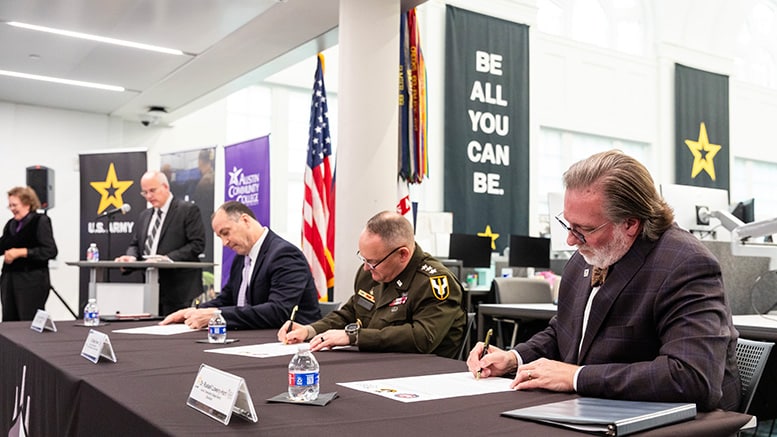
The Austin Community College District (ACC) and the U.S. Army this week signed a $16 million, 10-year agreement to expand a program that helps the Army develop innovation and technical talent among its soldiers through software development training and more.
The agreement builds on an $8 million, five-year pilot that officials say is a model for delivering mission-ready software while redefining how soldiers learn, collaborate and build advanced technical skills.
ACC’s Tech Accelerator assists the “Army Software Factory” in delivering academic programming through the college’s computer science and visual communications departments, according to ACC. The partnership leverages ACC’s instructional expertise, agile curriculum and ability to rapidly design responsive learning programs tailored to soldiers’ missions, according to a release.
“Our role is to create environments where soldiers can grow their skills, test ideas and do meaningful work that matters,” said ACC Chancellor Russell Lowery-Hart.
The program has caught the eye of the U.S. Marine Corps, which has partnered with the Army and ACC to launch its own Marine Software Factory at the college’s Rio Grande Campus. The partners are exploring how to further expand the program.
South Carolina college partners with Boeing on training
Trident Technical College (TCC) has announced a new partnership with Boeing South Carolina (BSC) to provide production and maintenance training as the company plans to expand operations.
A new five-year contract includes onboarding training for new Boeing workers and recertifying current employees who serve as assemblers and inspectors of the 787 Dreamliner airplane. The training will take place at TTC’s South Carolina Aeronautical Training Center and at Boeing’s North Charleston site.
Boeing expects to add 1,000 new jobs over the next five years to support its site expansion plans.
“By delivering Boeing’s proprietary training program, we are ensuring that local talent is ready to meet the demands of the aerospace industry,” said TCC President Vicky Wood. “Our contract represents a significant expansion of Trident Tech’s partnership with Boeing and a step forward in providing South Carolina’s skilled workforce for advanced manufacturing.“
Following the completion of TCC’s training, Boeing employees can advance to more specific on-the-job training at BSC with Boeing workplace coaches.
TCC already offers a 26-credit-hour aircraft assembly technology certificate, allowing eligible completers to bypass a traditional interview process and advance more quickly into Boeing’s hiring pipeline for certain entry-level positions.
Construction trades training to help rebuild after L.A. fires
The Construction Trades Lab at Pasadena City College will train construction industry workers to help with rebuilding efforts after last year’s devastating wildfires in Los Angeles.
Funding comes from LA Rises (a state initiative to support the rebuilding efforts), the Walter Family Foundation and state workforce recovery funds. The California Community Colleges Chancellor’s Office has provided $500,000 in state funding from a designated community college initiative fund to support workforce development and regional rebuilding programs in response to the fires.
“This lab is workforce infrastructure for a region in recovery,” California Labor Secretary Stewart Knox said in a release about the expanded construction lab. “Rebuilding Los Angeles will take years and thousands of skilled workers. Our role is to ensure workers are ready to meet what this moment demands, so recovery restores both homes and livelihoods.”
Over the past three years, nearly 2,400 students have enrolled in PCC’s building trades and technical education programs, including building construction, rough carpentry, welding, electrical and electronics technology, design technology and machine shop. The expanded construction lab will revamp training facilities and serve more students.
Fed Reserve on labor, AI
Employment in the U.S. remains steady, but companies continue have a hard time finding skilled labor, particularly in engineering, healthcare and other trades, according to the latest “Beige Book,” a summary by the Federal Reserve Bank of current economic conditions among the bank’s 12 districts.
The report notes that fewer workers appear to be switching jobs, and that more companies are exploring the use of artificial intelligence (AI), mainly to improve productivity and workforce management. It added that AI currently has a limited impact on employment, “with more significant effects anticipated in the coming years rather than immediately.”