
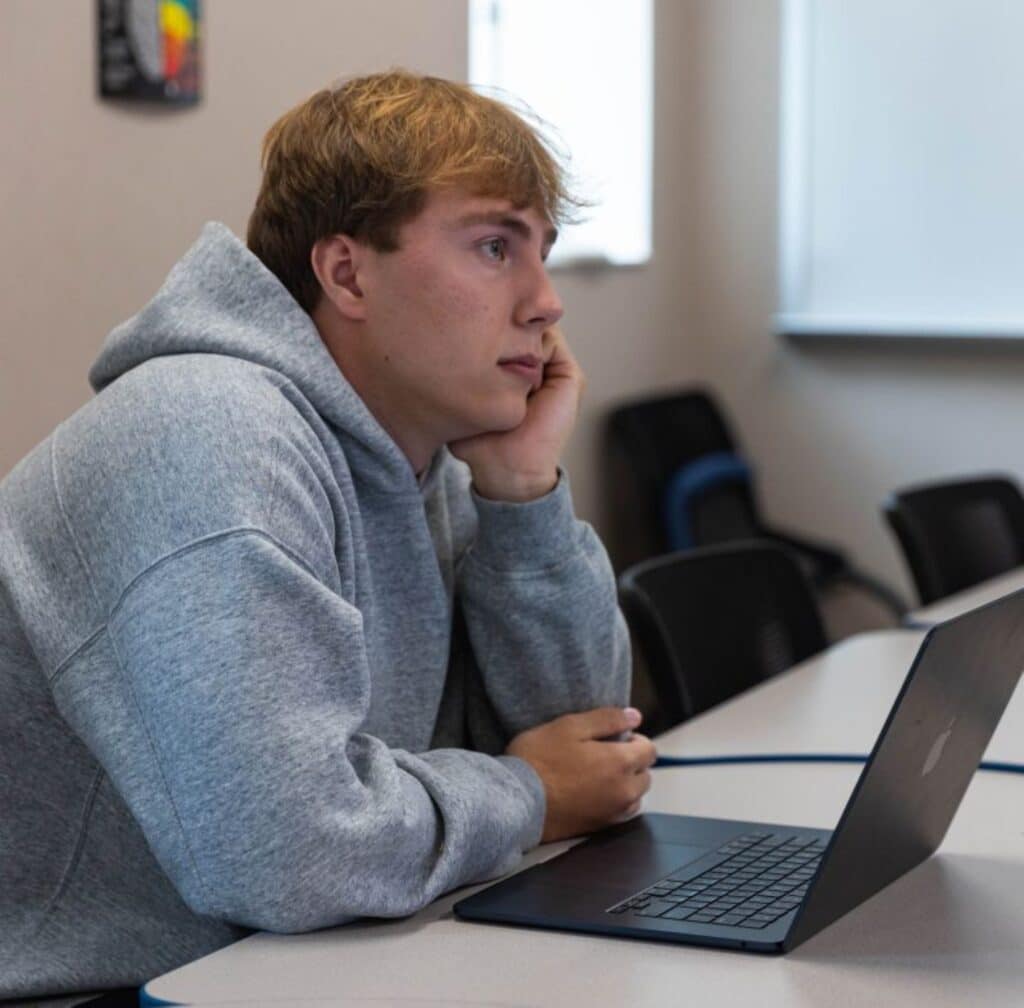
Costs associated with college aren’t trivial for Peyton Gire. For the Laramie County Community College (LCCC) sophomore in the Business & Accounting Pathway, the difference can be in the essentials.
“The cost of college overall can add up quickly, especially if you are paying for housing, tuition and other fees,” he said. “Having that extra money helps me afford essentials like food and gas.”
Knowing those little costs add up for students, an increasing number of LCCC instructors and support teams are exploring open educational resources, or OER. These are free, high-quality learning materials that can replace traditional textbooks, removing one of the most persistent financial barriers students face and helping align instruction with the college’s mission of access and affordability.
LCCC graduates average $12,500 in student loan debt for all types of credentials. That’s remarkably low compared to the national average — total average student loan debt (including private loan debt) may be as high as $42,673 per borrower. And Wyoming generally has a low student debt burden, with only North Dakota reporting a lower average debt and a lower year-over-year change.
The overall cost of college has risen sharply for students. Student loan debt is at historic levels, with borrowing levels ever-increasing. More than one-third of students consider dropping out because of financial pressure, and more than half struggle to cover basic monthly bills. A 2023 study found that nearly 83% of Wyoming students think higher education is out of their reach because of money.
Against that backdrop, all cost reductions improve a student’s ability to stay enrolled and succeed. In the last three years, it’s estimated that LCCC students saved between $462,000 and $746,000 in textbook costs due to the expanded use of OER.
Proponents of OER at LCCC know that implementing their approach on a wider scale comes with challenges. But for Chrissy Reynolds, a second-year applied management student who works full-time, it’s clear any purported trade-offs with OER are worth it for the students’ sake.
“Times have changed, and along with the times, technology has advanced,” she said. “Using OER not only helps students, but it can also help instructors utilize technology to better teach their students.”
Connecting with the librarian
OER became personal for LCCC Spanish instructor Ian Caldon when a student told him she couldn’t afford the required text for his Spanish in the Workplace course. Even though she purchased an older edition of the book, the student still didn’t have the access code from the more recent edition. Ian said the conversation changed him.
“When a student told me they couldn’t afford the book, that hit me hard,” Caldon said. “It made me realize I didn’t want to be part of a system where students couldn’t access the material they needed. I didn’t want to add barriers to someone’s education.”
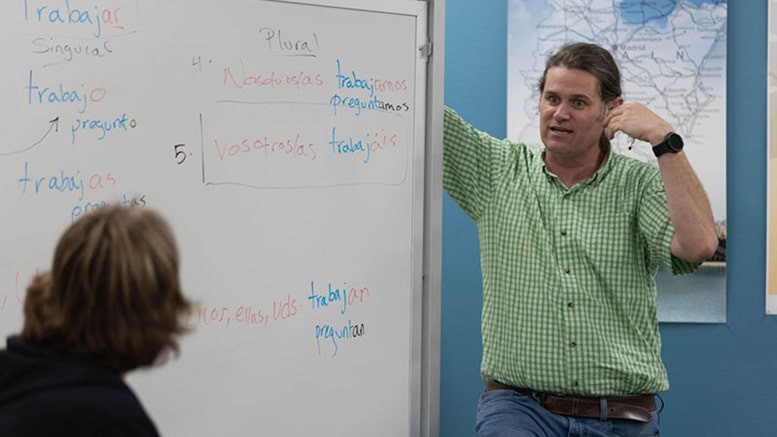
While Caldon said he had some familiarity with OER as a concept, he didn’t understand the scope until he contacted LCCC librarian Maggie Swanger.
“Once she walked me through the repositories, I realized how much high-quality material was available and how much better it fit what I wanted to teach,” he said.
LCCC’s Ludden Library can play a central role in helping faculty shift to low or no-cost materials for students, Swanger said. Instructors new to OER can find help in identifying open texts, vetted resources and high-quality materials faculty can build into their courses.
“We can help identify existing OER, or sometimes we can buy an ebook through one of our subscription sources so students can access it for free,” Swanger said.
Not just lower cost — it’s better
Danielle Adams, a Business & Accounting instructor, said her transition to OER reshaped how she thinks about teaching. She said the learning environment she experienced as a student — buying expensive textbooks and working in simulated accounting exercises — doesn’t match the reality her students live in today.

Building accounting assignments directly in Excel that build in complexity until students are solving full accounting scenarios, Adams said her students benefit not only from the savings but from learning in the actual tools they’ll encounter in the workplace rather than in a simulated environment.
Instructors often feel more invested in their teaching when they build the content themselves, gaining a deeper understanding of the material and a stronger connection to how students learn it, Adams said.
“In building all of this, I learned the material far more deeply, and that made me a better teacher,” she said. “I understood the assignments because I created them myself. I think instructors teach with more passion when they build their own materials. I teach my best when I truly understand my work.”
Don’t eat the elephant at once
Instructors shouldn’t feel overwhelmed when considering integrating OER in their courses, Caldon said.
“I used to think OER required a full course redesign or a sabbatical,” he said. “It doesn’t. Start small. Build it over a few semesters. You can make progress without burning yourself out.”
Chris Hair, a geoscience instructor in the STEM Pathway, said faculty don’t need to reinvent an entire course to begin using OER. Some classes rely heavily on the structure of a textbook, so a full transition can feel daunting. Instead, Hair said he encourages instructors to start with a single assignment or module, being a manageable step that builds confidence and momentum without requiring a complete redesign upfront.
“Creating one assignment or activity can take a weekend, and it’s a solid way to start,” he said. “I like to use the phrase ‘shrink the change.’ You don’t have to redesign everything at once. You can begin with smaller activities or assignments that are more focused.”
No tradeoffs in quality
Concerns about the quality of open materials still come up, but Swanger said those worries rarely align with the evidence. Students in OER-based courses overwhelmingly report that the materials are just as good or better than courses with a traditional textbook. A 2018 study even notes that the benefits provided from OER could lead to higher persistence and completion rates for community college students.
While there are areas of education where OER hasn’t developed or won’t apply in the same way, Swanger said access to quality material in general education subjects has improved dramatically in recent years, giving faculty multiple strong options to choose from.
The quality of the classes that student Peyton Gire took where OER was offered matched or exceeded those with required textbooks, he said, leaving him feeling prepared to succeed in college.
“I feel that I had equal or even better quality of education in these classes because I had access to the textbook if I needed it,” Gire said. “It was easier to access the [OER] textbook as well. In some classes that I did have to pay for a traditional textbook, I found that we did not use it as much or only parts of it, which makes the cost seem unnecessary.”