
- College affordability gap widens
- Seeking a stay on limiting veterans’ educational benefits
- In Ohio, a new initiative paves a path to a 4-year degree
- $10K for exceptional TRIO Student Support Services efforts
College affordability gap widens
A new analysis of college affordability by the National College Attainment Network (NCAN) says that fewer than half of community colleges are, on average, within reach for families, with the financial gap just under $500.
The annual report finds that 48% of community colleges are considered “affordable,” compared to 35% of public baccalaureate institutions. For community colleges, the percentage has increased since Covid, when 40% in 2019-20 and 42% in 2020-21 were seen as affordable.
The affordability gap for community colleges doubled from $287 to $486 in 2023-24, NCAN says. The widest affordability gaps for two-year colleges were during the Covid years, reaching $931 in 2020-21.
Even though the gap is less than $500, NCAN said it is concerning since community colleges are known for their open enrollments and lower costs of attendance than four-year institutions, which had a $1,555 affordability gap in 2022-23. However, NCAN said a relatively minimal increase in financial aid awards could lower or eliminate the gap for community college students.
NCAN’s analysis takes into consideration a college’s total price, emergency expenses, grant aid and student loans, Federal Work Study and other metrics. Its survey included 600 community colleges and 537 public four-year institutions.
The report includes an updated dashboard and refreshed state affordability profiles. Students, on average, had unmet need at community colleges in 20 states, the report says. Only six states — Connecticut, Indiana, Kentucky, Maine, Minnesota and Vermont — had community colleges that were all deemed as affordable. Another nine states had at least 75% of their community colleges meeting NCAN’s affordability criteria.
Seeking a stay on limiting veterans’ educational benefits
The American Association of Community Colleges is among 19 higher education groups asking a federal appeals court to hold off on implementing a new Department of Veterans Affairs (VA) policy that cuts eligibility to GI Bill educational benefits for veterans and their families by a full year.
VA last month issued guidance to limit the education benefits of veterans and their dependents under the Post-9/11 and Montgomery GI bills to 36 months, even though the U.S. Supreme Court has ruled that veterans eligible under both programs are entitled to receive up to 48 months of combined benefits. The higher education organizations have joined on an amicus brief that supports a legal challenge to VAs’ policy filed by the state of Virginia, veteran organizations and individuals.
For many eligible student veterans, the GI benefits cover full tuition and fees for in-state tuition at public institutions, the amicus brief says. Without the funds, many beneficiaries may have to drop out, it added.
“The VA’s rules leave student veterans who have exhausted three years of educational benefits in the position of approaching what may be their final year of college without the expected and promised resources for completing their education at the institutions that they have chosen to attend,” according to the brief. “Fall classes have already begun, and unless the VA’s policies are stayed, the real world impact of student veterans being unable to continue their educational journeys will materialize across the country.”
In Ohio, a new initiative paves a path to a 4-year degree
A new initiative in Ohio announced this week will allow eligible low- to middle-income state residents who earn an associate degree from Columbus State Community College to continue toward a baccalaureate at Ohio State University, which will cover tuition and mandatory fees.
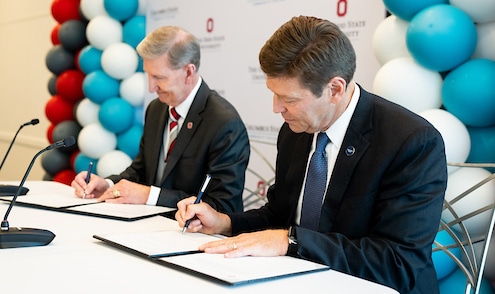
The Buckeye Bridge program is a key element of Ohio State President Walter “Ted” Carter Jr.’s “Education for Citizenship 2035” strategic framework, which focuses on access and affordability while serving the state’s workforce development needs, according to a release.
“Buckeye Bridge will have a transformational impact,” said Columbus State President David Harrison. “This is a guaranteed opportunity for a debt-free bachelor’s degree, designed to make it easy and predictable for students and families. Together, Columbus State and Ohio State are not only helping students launch successful careers, we’re strengthening the talent ecosystem that drives our region’s economic prosperity.”
More than 1,000 students per year transfer from Columbus State to Ohio State, the largest transfer partnership in the state. Buckeye Bridge is expected to increase that number. Buckeye Bridge will launch for students graduating from Columbus State in spring 2026 and seeking to start at Ohio State that fall semester.
$10K for exceptional TRIO Student Support Services efforts
The Council for Opportunity in Education plans to award a $10,000 grant to three community colleges that show an exceptional use of the federal TRIO Student Support Services (SSS) program to help advance student success at their campuses. College can apply by October 15.
The COE Award for Institutional Effectiveness aims to spotlight embedded, effective practices designed by using SSS funding — such as intrusive advising, cohort mentoring and data-driven evaluation — that help low-income and first-generation students enroll, persist and graduate, COE President Kimberly Jones said in a release.
COE will host an informational webinar on October 1. Email questions to Nicole Norfles.