
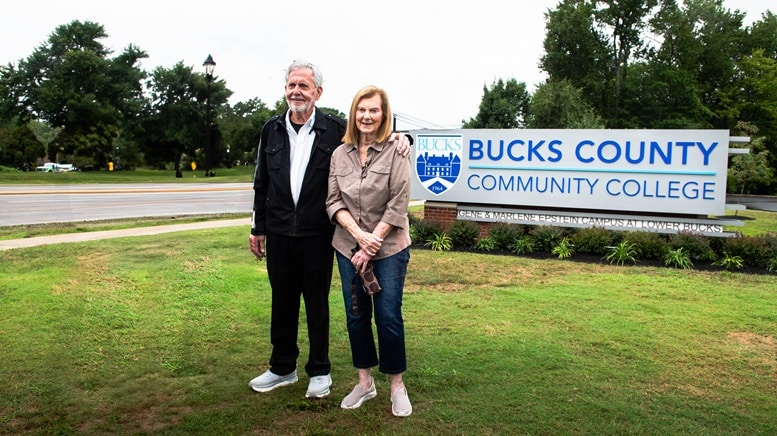
While unveiling a new gateway sign this month at Bucks County Community College’s Epstein Campus, philanthropist Gene Epstein announced the expansion of a scholarship program to help Lower Bucks high school graduates attend the college.
Last March, the Gene and Marlene Epstein Humanitarian Fund donated $100,000 to allow 100 students to attend their first year of college free of student debt during the 2025-2026 academic year. Epstein now has announced an additional 100 scholarships will be available in the 2026-2027 academic year.
Epstein also revealed a $1 million commitment towards future scholarships in the years ahead.
The campus, which opened in 2006 in Bristol Township as the Bucks County Community College Lower Bucks Campus, was renamed the Gene and Marlene Epstein Campus at Lower Bucks in 2016 to commemorate a donation from the Epstein Humanitarian Fund.
Alabama
The Alabama Community College System (ACCS) has received $300,000 in Fiscal Year 2025 Education Trust Fund Supplemental Appropriations. The funding, which comes through the Alabama legislature, will support the development and expansion of women’s sports in the Alabama Community College Conference (ACCC).
A large portion of the funds specifically will support the implementation and growth of women’s flag football as an ACCC-sanctioned sport, in addition to other conference ventures and initiatives related to women’s sports.
Alabama will be one of eight states to offer women’s flag football as a varsity sport once the inaugural season begins. Seven colleges in the state will compete this year: Bishop State, Calhoun, Lurleen B. Wallace, Northwest Shoals, Shelton State, Snead State and Wallace State Community College in Hanceville. Additional ACCS colleges have plans to launch women’s flag football teams in 2026.
“At one time, females didn’t have a path to continue to play flag football beyond high school,” Izell Reese, a Dothan native and executive director of NFL Flag, said in a release. “It’s phenomenal to now hear of the opportunities that are going to come at the community college level.”
Florida
The College of Central Florida (CF) Foundation can provide financial assistance to college students who may not qualify for other financial aid, thanks to a $70,000 grant from the Edward K. Roberts Community College Fund of the Community Foundation of Sarasota County. The scholarship criteria prioritize students who are parents and are working to better themselves and their families through education.
“Since 2020, the Edward K. Roberts Scholarship has helped 183 CF students overcome financial obstacles on their journey to a degree. This is a transformational scholarship — especially for part-time students and student-parents, helping cover both academic costs and essential living expenses that can be the biggest barriers to graduation,” Chris Knife, vice president for institutional advancement and CEO of the CF Foundation, said in a press release.
* * *
St. Petersburg College (SPC), the University of South Florida (USF) and LEAP Tampa Bay College Access Network are celebrating a milestone in student support and financial access, thanks to a $250,000 gift to the Community Foundation Tampa Bay from Suncoast Credit Union.
The donation will support the Fuse Scholarship Program, established by LEAP Tampa Bay partners at the Community Foundation. The Helios Education Foundation is matching this $250,000 donation. Nearly 50 SPC students are expected to benefit from the contribution as they pursue a four-year degree through the Fuse program at USF.
The Fuse program, a partnership between SPC and USF, offers students a streamlined, affordable route to a bachelor’s degree. Students who enroll in Fuse complete their associate in arts degree at SPC with the guarantee of admission into select USF programs, provided they meet the academic requirements. The program includes structured advising, mentorship and financial assistance to remove common barriers that often delay or derail academic progress.
North Carolina
Pitt Community College will get new welding equipment thanks to a $3.1 million grant from the Golden LEAF Foundation.
“With this new equipment, the college will more than double its training capacity to meet the high demand for welding skills by employers in the region,” said Golden LEAF President and CEO Scott T. Hamilton.
The equipment will bolster PCC’s new 30,000-square-foot welding building, which is expected to be completed in January.
Though Pitt has the state’s largest welding program, Keith Kinlaw, interim dean of PCC’s construction and industrial technology division, said the college has been limited by its current welding training facility — both in terms of student capacity and certification opportunities — for more than a decade.
“There’s programming we’ve wanted to add over the years but couldn’t because of space constraints,” Kinlaw said. “Being able to finally explore those options, knowing we’ll have the ability to offer them and further enhance training for our students, has been a welcome change.”

North Dakota
The North Dakota University System awarded Lake Region State College (LRSC) $1 million in Workforce Education Innovation Funds to expand allied health apprenticeship programs.
According to LRSC Interim President Carmen Simone, the funds will support the development of allied health apprenticeship programs in collaboration with Altru Health System. Programs include surgical technology, laboratory technology, respiratory therapy and ultrasound/sonography.
The funds, appropriated this last legislative session, go toward the creation or enhancement of educational programs that address the workforce needs of North Dakota business and industry.
These programs combine employer-sponsored clinical training with academic coursework, include articulation agreements for four-year degrees, and aim to expand youth apprenticeships in collaboration with local schools, supporting workforce development and employer-staff retention.
Oregon
Klamath Community College’s (KCC) computer technology department has received a nearly $1 million National Science Foundation grant. The project will help high-achieving, low-income computer engineering and cybersecurity students complete their programs while contributing to the workforce in southern Oregon.
“When it comes to our computer engineering technology program at KCC, we punch way above our weight,” said KCC program lead Pete Brandsness. “Our cybersecurity program is nationally recognized and has been designated as a Center for Academic Excellence, a national standard that is very rigorous to meet and maintain.”
The grant will provide scholarships for 23 eligible students – across five, two-year cohorts – who are pursuing an associate of applied acience degree in computer engineering technology and cybersecurity and networking.
West Virginia
The West Virginia Council for Community and Technical College Education has approved Technical Program Development Grant awards totaling more than $1.04 million for five programs that directly address employer needs.
Among the grantees is Eastern West Virginia Community and Technical College’s new applied artificial intelligence certificate program, which received $169,440 in funding.
BridgeValley Community and Technical College received $215,325 to establish a fully accredited respiratory therapy associate degree to address a shortage of respiratory care professionals following the closure of a regional training program.
In Southern West Virginia, where tourism remains a key economic driver, Southern West Virginia Community and Technical College is meeting that demand with a $219,580 grant for a new hospitality and tourism management associate degree.
Emergency medical care is another urgent need, and West Virginia University at Parkersburg will use its $220,000 award to launch an emergency medical services associate degree focused on advanced paramedic training in partnership with WVU Medicine.
Wisconsin
Mid-State Technical College secured a $200,000 gift from County Materials Corporation in support of the college’s Wayne H. Bushman Advanced Manufacturing, Engineering Technology, and Apprenticeship (AMETA) Center.
The company’s gift secures lifetime naming rights in one of the center’s classrooms.
County Materials manufactures concrete construction products that support essential infrastructure, including bridges, stormwater management systems, parking lots and structures, warehouses and retail complexes.
“For our organization and our family, this collaboration is both personal and purposeful. We see it as an investment in people – a way to foster growth, learning and success that will multiply throughout our organization and the wider community,” said Rebecca Sonnentag, executive vice president of marketing and communications at County Materials Corporation.