
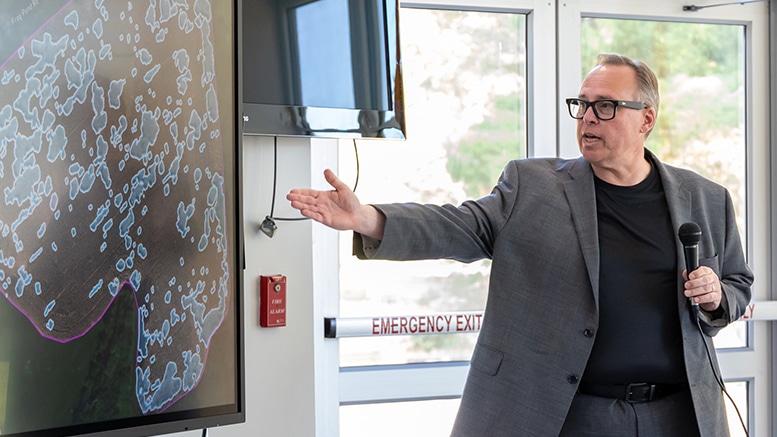
Two New Jersey community colleges have collaborated on a unique forum about the future of agriculture in the northwest part of the state, bringing together leaders in farming, education and politics with the hope of creating a catalyst to support and modernize a key sector of the state’s economy.
Leaders from Sussex County Community College (SCCC) and Warren County Community College (WCCC) invited speakers and interested guests to the innovative forum in October to discuss ways to mitigate challenges for state farmers and help them thrive.
Joseph Labarbera, WCCC’s dean of accountability, said the forum focused, in part, on ways to substantially boost New Jersey’s $7 billion agricultural GDP, a goal in which community colleges could play a significant role. He noted that this first meeting of the Northwest New Jersey Agricultural Economic Development Conference built relationships and established priorities for next steps, including similar sessions in the future on specific sectors within agriculture.
Another meeting is tentatively planned for April, focused on beef cattle, and others are planned around equestrian businesses in the state, better marketing of state-produced agricultural goods and the use of precision agriculture to make farms more productive and environmentally sensitive. Labarbera said he hopes the coalition will also focus on state policy affecting farmland, the efficiency of the agricultural supply chain and structures for marketing farm products.
Leading the discussion
WCCC President Will Austin, whose team developed the concept, said the two community colleges were the key drivers of the effort and noted that leaders at both believe engagement in agriculture is important for their students, communities and the state.
“This was a unique opportunity to bring together experts who work in farming or who undertake agricultural research or make policy so they could exchange the latest information and develop strategies for the protection and growth of this key segment of our economy and central part of our communities,” he said. “There is a reason New Jersey is known at the Garden State.”
SCCC President Cory Homer, whose college hosted the event, agreed and noted that the forum is a unique opportunity for the two campuses to play a leadership role in bringing together those leaders who can offer varying perspectives.
“We were proud to host the Northwest New Jersey Agricultural Economic Development Conference, a critical platform for advancing the future of agriculture in our region,” he said. “As a community deeply rooted in farming heritage, we recognize the importance of supporting innovation, sustainability and economic opportunity for our agricultural sector.”
Range of topics
The forum focused on challenges faced by farmers, including the preservation of farmland, new technology, international export strategies, and the value of the equestrian sector and other specific or niche farming businesses.
Those invited included farmers, horse breeders, landowners, agribusiness professionals, and faculty and students from the two colleges and other higher education institutions in the region, along with their students and students in high school agriculture programs.
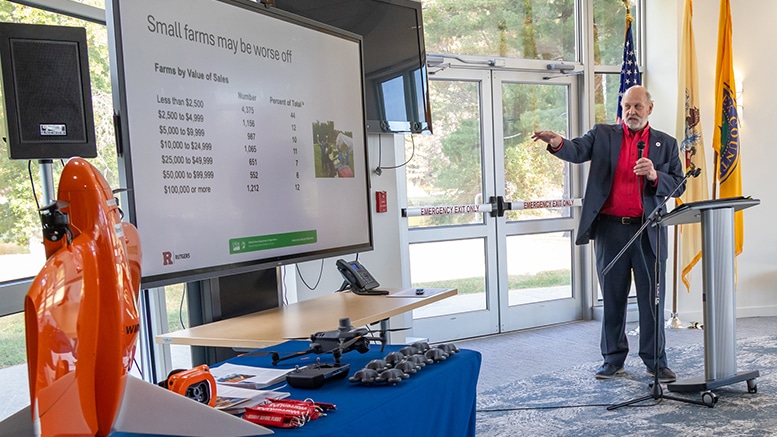
The speakers included Frank Minch, director of the state Agriculture and Natural Resources Division, to discuss exporting to global markets, and Homer, who led a roundtable about a vision for agriculture in the state over the next decade.
Labarbera discussed farmland as an equity hedge, and Austin reviewed the latest innovations with drone use in precision agriculture, a focus for Warren’s nationally recognized drone-training program.
Kathryn Giovanelli, state president of the Future Farmers of America, discussed her concerns about the prospects for careers in farming, prompting a discussion about the ways agriculture will take shape in the state and how institutions such as community colleges should respond.
Warren’s focus on drone technology and specifically on precision agriculture is one way the colleges can support the agriculture community, offering research and guidance on the use of automated systems to assess and enhance their land and plant or harvest crops.
Other invited guests include retired state Senate Minority Leader Steve Oroho, Michael Campbell from the Thoroughbred Breeders’ Association of New Jersey, and Jack Degroot, a Sussex County commissioner. Along with presentations and discussions, the event included student demonstrations showing the many uses of drones. A networking lunch, featuring New Jersey-grown products, offered attendees opportunities to meet with stakeholders across education, business and agriculture.
Overview of the industry
The New Jersey Department of Agriculture reports that food and agriculture are New Jersey’s third-largest industry, generating billions of dollars in revenue for the state. In 2022, the state’s almost 10,000 farms generated cash receipts of nearly $1.5 billion. The nursery/greenhouse/sod industry is the leading commodity group, followed by fruits and vegetables, field crops, equine, poultry and eggs, and dairy.
“Retaining productive, taxpaying farmland is critically important to all New Jersey residents since agriculture is the largest single source of the scenic vistas throughout the state,” the department reported.

Farmers in the Garden State produce more than 100 different kinds of fruits and vegetables for consumers in New Jersey and the rest of the U.S., in Canada and in many countries around the world. Nationally, New Jersey is one of the top 10 producers of blueberries, cranberries, peaches, tomatoes, bell peppers, eggplant, cucumbers, spinach, squash, as well as flowering plants.
In addition, growers also produce hundreds of thousands of dollars’ worth of specialty crops. Vineyards, for example, are a growing segment of the industry, enabling the state’s more than 50 vintners to develop a wide variety of wines.
