
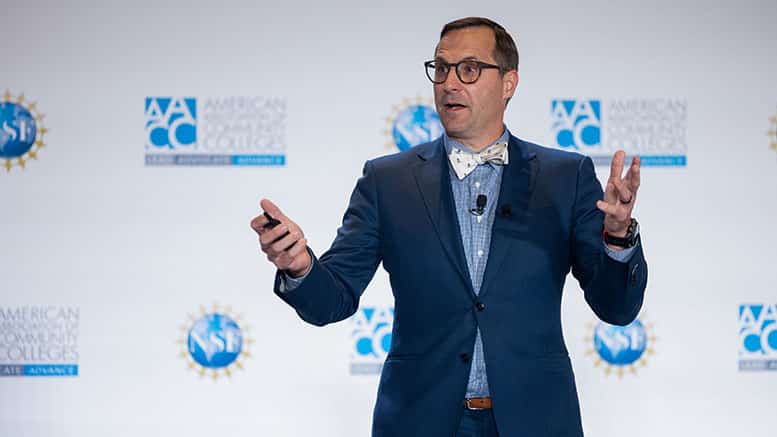
Futurist, economist and author Shawn DuBravac told the Advanced Technological Education (ATE) principal investigators that the way they collaborate is their “superpower.”

At a time when many enterprises focus on protecting proprietary information, DuBravac said ATE grantees’ willingness to share the outcomes of their National Science Foundation-funded work stood out to him during his study of the ATE program.
Before he gave the closing plenary address at the 2025 ATE Principal Investigators’ Conference last Thursday, DuBravac spent time the afternoon before talking with conference attendees. Earlier in October, he visited Northern Virginia Community College to learn about its ATE-funded data center technician education project.
While all institutions and individuals awarded NSF grants are required to disseminate their findings, the ATE community has a strong history of openness and enthusiasm for partnerships that improve technician education for all students. This year’s 800 conference attendees included teams from 243 community and technical colleges with active ATE grants. Since it was created in 1993 by NSF, the ATE program has invested $1.5 billion in innovative technician education initiatives that involve two-year college educators in leadership roles.
“You have this unique ability to collaborate because you’re not competing in traditional ways. And so you can share your expertise, you can share your learnings, you can share your insights, and that is an absolutely phenomenal, wonderful thing that I think will push community colleges far ahead of many other institutions in a world where technicians will play a much more important role in the decades ahead,” DuBravac said.
Challenges and opportunities
DuBravac, president of Avrio Institute, who has written the best-seller Digital Destiny, taught as an adjunct at several universities, and served as chief economist at the Consumer Technology Association. He described to ATE attendees the massive changes in the energy, infrastructure, digital layers of the economy and in the frontiers of space and quantum computing as both challenges and opportunities for educators of technicians. He cited the rapid integration of artificial intelligence (AI) in business practices since ChatGPT launched 36 months ago as an example of the current accelerated rate of technological changes.
“One of your great challenges is how do we train students, especially when we have them just for a very short time, on some of the latest technology, when it will still be several years until that technology is fully embedded inside of products, inside of businesses and ultimately transforms industries,” he said.
DuBravac repeatedly encouraged educators at primarily community and technical colleges to look at “first principles” as they compete in redefining markets. He recommends two-year college educators build enduring competencies, calibrate the present and the future, expand human capacity, build curiosity and collaborate.
“Competencies are the currency of the future. It is the competencies that are going to drive us forward and ultimately drive your students forward. In an age of AI … the value of knowledge starts to decay,” he said, pointing out that when technical educators focus on first principles, skill sets “rise to the top.”
DuBravac recounted the technological shifts led by newcomers that eliminated the ice industry that employed more than 100,000 people in the 1800s to illustrate that incumbents — business, organizations and individuals — often fail to leap to new opportunities.
“We have to be able to look across competing time horizons. We have to be able to not just see what’s happening now, but also see how do we build the institution that’s going to be relevant in 10 years from now?” he said.
Small steps add up
To expand the capacities of students and faculty, DuBravac encouraged instructors and administrators to consider the small changes they can make. To illustrate how small changes can accumulate for substantial improvement, he explained how Dave Brailsford, the performance coach for the British cycling team, broke down every aspect of competitive cycling to improve each component by just 1%. In only a few years, the team began winning major races.
“I think sometimes we look at the problems that we face and we feel like, ‘Oh, these are such big challenges. Where do we even begin?’ But if we can break it down to very small changes, one degree shifts, one degree decisions and put those together, I like to say we’re looking for transformation with a small T,” he said, adding, “Don’t think that you have to rewrite everything, but are there small things that you can do?”
DuBravac closed by reviewing how chess grandmaster Garry Kasparov took the bruising experience of first beating and then losing to IBM’s Deep Blue computer to create free-style chess tournaments where individuals and teams of humans can compete along with computers. He reported that Kasparov has found that in chess competitions a weak human plus a machine and a better process is superior to a strong computer alone, and, more remarkably, superior to a strong human plus machine, plus inferior process.
DuBravac’s takeaway is this: “It is not the best people with all of the knowledge that are winning. But it’s also not the technology that’s winning. It’s not enough to have the best people, but it’s also not enough to have the best technology.
“You have to figure out how do we bring them together? How do we take the best technology, the best people, and change the processes to get a better outcome? What does that look like when we pull all of these things together?
“I think that’s true for your faculty. I think it’s true for your students. How do we pull them together? Not just giving them tools, but embedding this knowledge, embedding these tool sets so that they form their own super teams … to create an entirely new way of competing.”